
Or shall we call it ‘The Richards’ ?! Instead of ‘The Champagne Oscars’ ? We want to sum-up the year of 2025 from a Champagne perspective. In 20+ categories we hand out awards for this years most memorable Champagnes & Champagne related topics!
Estimated reading time: 3 minutes

Historical winners
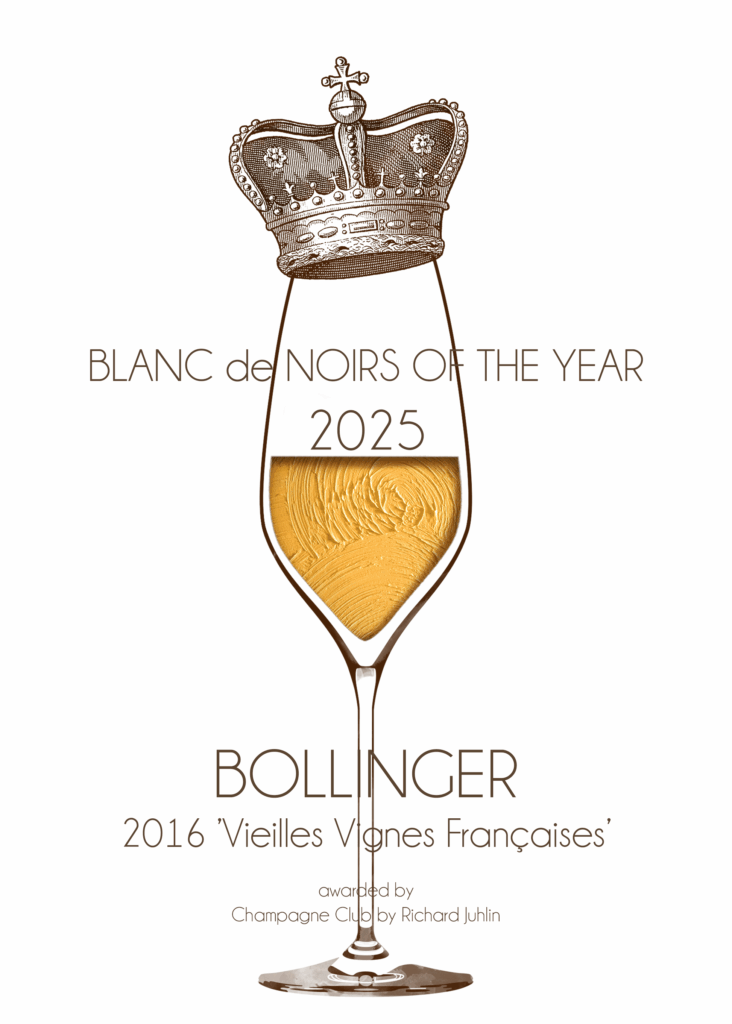
| 2025 | 2016 Bollinger ’Vieilles Vignes Françaises’ |
| 2024 | 2014 Bollinger ’Vieilles Vignes Françaises’ |
| 2023 | 2012 Bollinger ’La Côte aux Enfants’ |
| 2022 | mv Selosse ‘La Côte Faron Aÿ’ [base 2015] |
| 2021 | 1996 Krug ’Clos d’Ambonnay’ |
| 2020 | mv Selosse ’Bout du Clos d’Ambonnay’ [ base ’06 – dérgorgement may’18 ] |
Vieilles Vignes Françaises : the eternal taste and soul of Champagne
The Vieilles Vignes Françaises are intrinsically linked with Champagne Bollinger’s history. In the ungrafted vines, there is a memory that was almost lost: an extraordinary, moving reminder of our cultural heritage, of the Champagne region before phylloxera. Miraculously, two plots survived this outbreak, Chaudes Terres and Clos Saint-Jacques in Aÿ. Maison Bollinger’s Vieilles Vignes Françaises are made exclusively from these legendary parcels.
Both are classified as Grand Cru and are still grown in the old en foule way, using a traditional layering method known as provignage.This technique, which has been meticulously passed down, helped Maison Bollinger achieve the label Entreprise du PatrimoineVivant (Living Heritage Company or EPV) in 2012, an official recognition for French companies that demonstrate exceptional artisanal and industrial expertise.
‘One of the few perfect champagne houses and a beautiful gift to mankind.’
Richard Juhlin

2016 Bollinger ’Vieilles Vignes Françaises’
98(97)p
100PN
TASTING NOTE by Champagne Club by Richard Juhlin ‘ I know, of course, that I will be in for a grand experience every time I encounter a new vintage of ungrafted Bollinger Vieilles Vignes Françaises from the two small vineyards of Chaudes Terres and Clos St Jacques, outside Bollinger’s legendary house in Aÿ. Yet I was surprised that the wine was so powerful from such a light vintage as 2016. In the glass next to me was the sister wine 2015 Bollinger La Côtes aux Enfants which in 2014 was almost as powerful as the VVF when Björnstierne and I tasted them at Old Man Storr in Scotland. Therefore, it was very surprising that the warm year of 2015 resulted in the lightest and most sublimely fine-tuned La Côtes aux Enfants to date and that the 2016 VVF rumbled forward with a completely different muscularity and concentration. Denis Bunner asked me which vintage of VVF this colossal 2016 was most similar to when newly launched. After a few minutes of searching in my memory bank, I came to the conclusion that the 1985 VVF behaved in a very similar way. What I remember about that wine was that it was as flamboyant and honey-saturated d’Yquem-like as the 2016, but that it quickly went into an unusually long hibernation and closed like a clam and picked up speed somewhere around the 20-year mark. We’ll see if this wine follows the same pattern and let’s hope that the meager 1736 bottles are not drunk during the sleeping beauty’s sleep. Now newly launched, the wine is fantastic with a deep sparkling golden color. In the aroma, I am met by a heavy orchestra with brass and drums. Honeysuckle, honey, milk chocolate, oak, caramel, nougat, blackberry, ripe yellow peach, apricot and Moroccan leather constitute the most important components of the aromatic symphony. The incredibly concentrated taste plays on exactly the same theme, but has also been gifted with a new element of fig, sweet lemon pie and exotic fruits that I did not find in the fragrance package. In the aftertaste, the nougat note transitions to pure hazelnut from Piedmont. Another giant is born to enrich the ultimate wine world elite. The gratitude I feel is boundless and becomes almost even greater when you think that the phylloxera could attack the two small plots of land in Aÿ at any time. So we never know if the latest vintage will be the last.’

Bollinger
★★★★★
The most colorful person in the history of the house is his widow, Lily Bollinger, who kept a watchful eye on every bunch of grapes by cycling through the vineyards regularly. Her rigorous demands for quality still run through the house to this day.
Now Bollinger is run by Charles-Armand de Belenet, who control over 178 hectares, (104 with pinot noir) providing 70 percent of the grape supply. Most of of the wines are Selection Massalle no 386 planted in the twenties. The winemaker today is the wonderful “terroirist” Denis Bunner. Besides the house’s exceptional vineyards, they also use very expensive vinification methods. All the vintage wines are fermented in small, aged oak barrels and are never filtered. Malolactic fermentation—which would probably take place very late in the process—is not encouraged either. The reserve wines are stored at low pressure in magnums.
‘Bollinger make the heaviest and most full-bodied champagnes of any house, and their wines always have a smoky and hazelnuty complexity that is very hard to beat.’
Richard Juhlin