
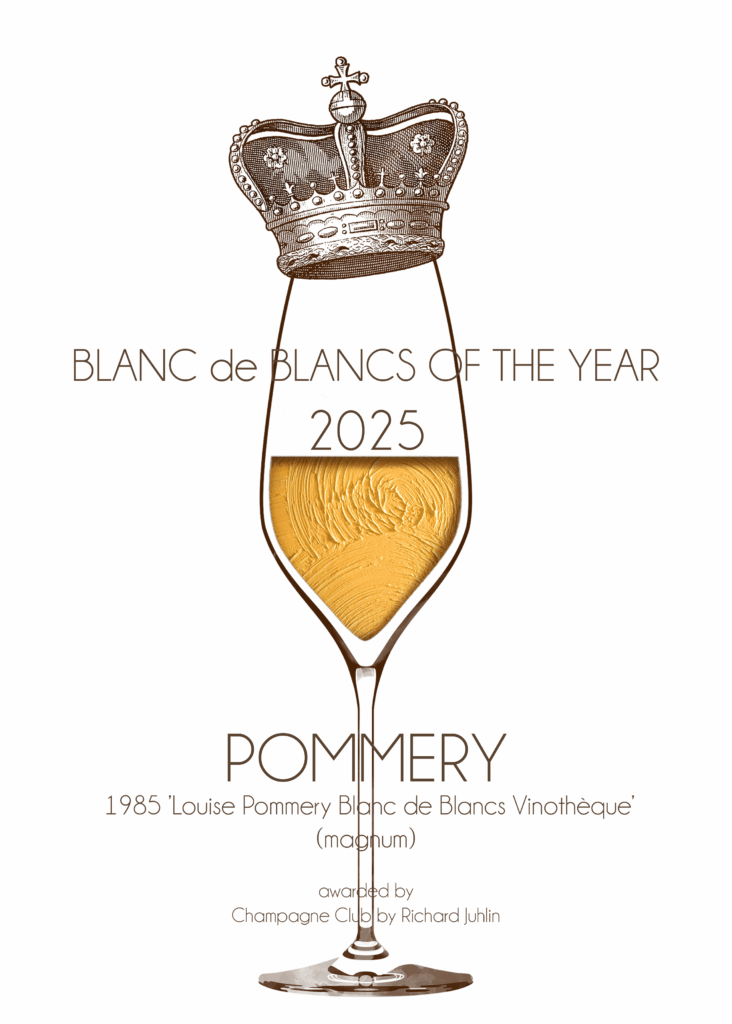
Or shall we call it ‘The Richards’ ?! Instead of ‘The Champagne Oscars’ ? We want to sum-up the year of 2025 from a Champagne perspective. In 20+ categories we hand out awards for this years most memorable Champagnes & Champagne related topics!
Estimated reading time: 3 minutes

Historical Winners
| 2025 | 1985 Pommery ‘Louise Pommery Blanc de Blancs Vinothèque’ |
| 2024 | 2008 Krug ’Clos du Mesnil’ |
| 2023 | 1976 Taittinger ’Comtes de Champagne ’ |
| 2022 | 2008 Krug ‘Clos du Mesnil’ |
| 2021 | 1959 Franck Bonville ‘Vinothèque’ |
| 2020 | 1998 Mumm ‘Mumm de Cramant Vinothèque’ magnum |
Pommery
★★★★
In 1856 Pommery & Greno was founded after having been known as Dubois-Gossart for the previous twenty years. The firm established a sales channel to the English as early as the nineteenth century, and were pioneers with their dry Champagne—quite without dosage. The Marquise de Polignac was one of the first owners, and one of her direct descendants, Prince Alain de Polignac, was for a long time the man in charge of assembling the cuvées. Prince Alain is a fascinating man who, better than any other winemaker, can describe the philosophy behind his winemaking art. In 1990, Pommery was one of those firms that ended up as part of the powerful Moët-Hennessy Group, and in 2002 Vranken took over.
But the house-style remains intact, thanks to Thierry Gasco, who was trained by the prince and still works together with the new skilfull winemaker Clément Pierlot. Pommery is one of the biggest Grand cru landowners. Besides Pommery’s own grapes, 70 percent of their supply comes from throughout Champagne, and they are vinified in modern style. Pommery is undoubtably a great name in historical terms. The house-style is made up of dry, restrained, pure champagnes with young fruit and an unmistakable steeliness that takes many years to round off.
The cuvée de prestige, Louise Pommery, doesn’t fit that description since its silky and soft directly with a pure flowery bouquet from Avize and a soft structure from Aÿ. I have been amazed time and again by the greatness of the older vintages from Pommery. Only recently I bought a large number of bottles dating from 1911 to 1979, which have lain untouched since birth in the dark recesses of Champagne. Every bottle that I’ve opened has been fantastic. The modern portfolio is also impressive and aristocratic. The vintage wine is the best wine for the cellar. Magnums of the fantastic 2004 is still around and Louis Pommery Rosé is the hidden secret.

1985 Louise Pommery Blanc de Blancs Vinothèque (magnum)
100CH
99(99)p
TASTING NOTE by Champagne Club by Richard Juhlin ‘First, let me start by telling you that these extremely rare magnum bottles that you are about to read about are unbelievably good. Next, I would like to proudly tell you that I guessed both the wine and the vintage correctly without even knowing its existence. I was simply guessing a Cuvée Louise Pommery Vinothèque magnum from 1985, but it tasted like a Blanc de Blancs from their Avize and Le Mesnil vineyards without the body from Aÿ which is always normally part of the Cuvée Louise recipe.
I guess I would never have dared to guess so accurately and oddly if it wasn’t “The one and only” Andrius Smaliukas who opened it blindly for me and some friends. Only he can track down such treasures directly from the champagne houses. If there had ever been a Louise Pommery Blanc de Blancs, he would of course have sought it out. It had been made!
Only once in history did Prince Alain de Polignac and Thierry Gasco consider Pinot Noir from Aÿ to be too heavy and dominant in the cuvée, namely in 1985. Although I am a big supporter of the often underrated prestige champagne Cuvée Louise Pommery, I have always believed that it is a difficult challenge to make heavily Chardonnay-dominated prestige cuvées because the blue grapes often take away some of the finesse and florality of Grand Cru Chardonnay. At the same time, it is rare that the Pinot Noir part has the strength to burst into aromatic full bloom. Usually, that part provides mostly structure and depth unless it reaches at least 50 percent or more of the cuvée. In most vintages, it takes up to 20 years before both parts provide full aromatic joy and structural perfection in Louise. The regular commercial 1985 in bottle format has as usual 40 percent Pinot Noir from Aÿ and it was not at all harmonious for the first 20 years.
At the age of 30, it became magically balanced with enormous depth and now belongs to the very best vintages made by the house. However, I have never tasted it in a magnum or in a Vinothèque version. I hope Clément Pierlot one day unearths one if they remain in the cellars of Reims to compare with my euphoric indelibly fresh memories of the epiphany the 1985 Blanc de Blancs just created in my brain and soul. The wine had that elusive volatility that the greatest Blanc de Blancs can have when they are still embarrassingly youthful and at the same time have developed faint but deep notes of provident maturity. My associations of similar experiences go to the 1969 Jacquesson Blanc de Blancs at thirty years of age and indeed also to the greatest of them all.
My only 100-pointer after 15,500 champagnes tasted, the 1928 Pol Roger Blanc de Blancs Grauves Vinothèque. The same green shimmering young color. The same bright aroma spectrum of lilies of the valley, lime blossom, orange blossom, white lilacs, lime peel and the purest chalk backed by a weak, but incredibly beautiful bouquet of Madagascar vanilla, nougat, coconut, peach and milk chocolate. The first attack on the tongue is tingly and energetically expectant. Small brisk bubbles tickle the entire oral cavity while the aromas from the fragrance welcome a wave of silky caress. A little more orange in the taste and the lime notes become less pronounced. As the sensual and extremely long aftertaste wanes in strength, the sweeter notes take over from a cannonade of chewy belemnite chalkiness. Thank you Pommery and thank you Andrius and not least thanks for my brain, nose and taste buds can still track down seemingly impossible wines through detailed analysis and full focus after the 60′ stretch. The old man still got it!’
‘Each vintage of this delicate and pale nectar is world-class.’
Richard Juhlin