
A great bottle of Champagne rarely survives the evening untouched. Yet even among serious wine drinkers, many still resign themselves to the idea that once the cork is out, the wine is essentially finished by morning. That is not quite true. If you know how to store opened champagne correctly, you can preserve a meaningful share of its sparkle, precision, and charm for another day – sometimes longer than most people expect.
The key is to understand what is actually being lost. Opened Champagne is not simply “going flat.” It is losing carbon dioxide, yes, but also aromatic lift, tension, and the fine interplay between fruit, acidity, autolytic depth, and texture that gives the wine its distinction. Storage, then, is not just about saving bubbles. It is about preserving as much of the wine’s identity as possible.
How to store opened champagne without ruining it
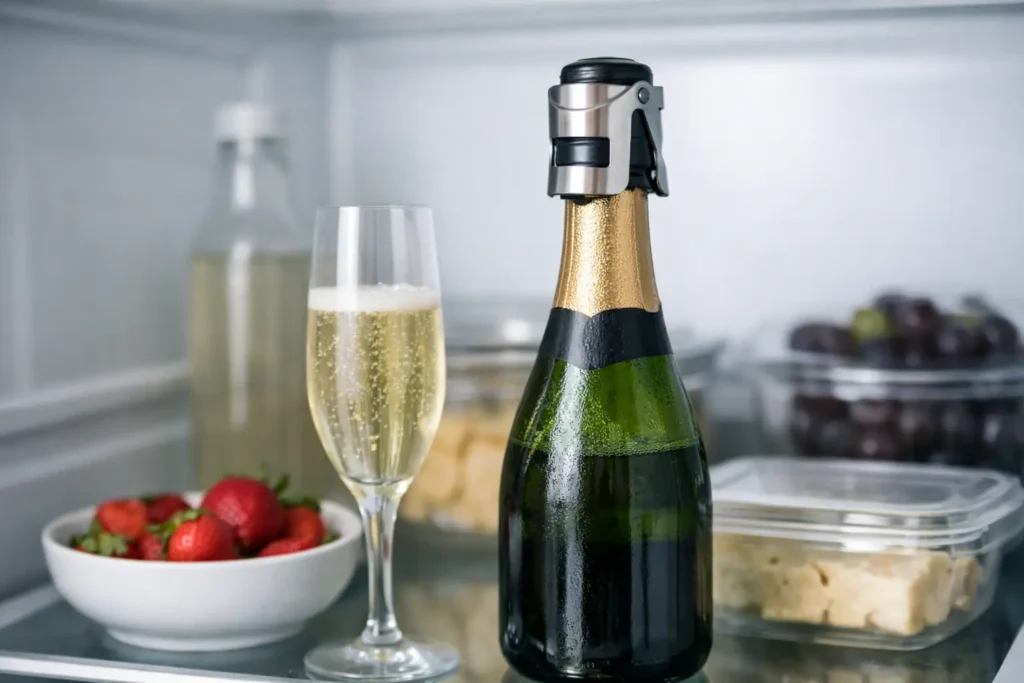
The best approach is simple: reseal the bottle immediately with a proper Champagne stopper and return it to the refrigerator. Cold temperature slows the escape of carbon dioxide and helps preserve freshness. The longer the bottle sits open at room temperature, the faster the wine loses energy and aromatic definition.
A dedicated Champagne stopper matters more than many drinkers realize. Still-wine stoppers are usually inadequate, and improvised solutions such as a spoon in the neck are more myth than method. Champagne bottles are under pressure, and a stopper designed for sparkling wine creates a tighter, safer seal. Good models lock onto the lip of the bottle and reduce leakage while maintaining enough security to handle internal pressure.
Once sealed, keep the bottle upright in the refrigerator rather than on its side. With an opened bottle, upright storage reduces the surface area of wine exposed to air inside the neck. It is a small detail, but small details are often what separate acceptable Champagne service from polished Champagne service.
The first 24 hours matter most
If you want the wine to show well the next day, speed is your ally. Pour what you need, reseal the bottle, and chill it again. Do not leave it on the counter during a long dinner if you already know there will be wine left over. That extra hour or two at room temperature can be the difference between lively and merely drinkable.
Most non-vintage Champagne will remain enjoyable for 1 to 3 days after opening if stored well. On day one, a strong bottle may retain much of its mousse and aromatic profile. By day two, the bubbles are often softer, but many wines still offer pleasure, especially those with solid acidity and a more vinous build. By day three, expectations should shift. The wine may still be useful and interesting, but rarely at its original standard.
Prestige cuvées and vintage Champagne can be a little more nuanced. Some hold their shape better because they begin with greater concentration and structure. Others feel more fragile because their aromatic complexity is part of what fades first. A young, tightly wound vintage wine may perform surprisingly well on day two. An older, more delicate bottle may not.
What affects how long opened Champagne lasts
Not all Champagne declines at the same pace. Dosage, bottle age, producer style, and serving conditions all play a role.
A youthful Blanc de Blancs with high acidity can sometimes seem quite resilient, even as the mousse softens. A richer Pinot Noir-dominant cuvée may lose its edge more quickly if warmth accelerates oxidation. Rosé Champagne is similarly variable. Some gastronomic rosés remain compelling after the fizz recedes slightly, while more delicate examples can feel hollow once their sparkle diminishes.
Bottle age matters as well. An older Champagne that has already developed tertiary aromas is usually less forgiving after opening. Its beauty may still be there the next day, but often in a quieter, less kinetic form. If the bottle is rare or mature, it is generally better to finish it the same evening rather than rely on storage.
Then there is the question of how much wine is left in the bottle. A nearly full bottle stores better than one with only a glass remaining. More empty space means more oxygen, and more oxygen means faster aromatic loss. This is one reason leftover Champagne from a large gathering often disappoints the next day – not because the wine was poor, but because too little remained.
How to store opened champagne for the best next-day glass
If your goal is not merely preservation but pleasure, treat the second serving as thoughtfully as the first. Keep the bottle very cold, but do not serve it ice-cold straight from the back of the refrigerator if you want to assess it properly. Give it a few minutes so the aromas can begin to open.
When you pour, use a clean glass and avoid aggressive movement. You are working with a wine that now has less internal pressure, so rough handling strips away what remains of the mousse. A white wine glass often shows reopened Champagne better than a narrow flute because it lets the reduced aromatics express themselves more fully.
This is also where expectation management becomes part of connoisseurship. A reopened bottle should not be judged against its just-opened state. The better question is whether it still offers balance, freshness, and enough effervescence to be pleasurable. In many cases, the answer is yes.
What not to do
The old spoon-in-the-bottle trick remains one of the most persistent Champagne myths. It does not meaningfully preserve carbonation. At best, it gives the illusion of doing something useful. At worst, it delays proper storage while the wine continues to fade.
Plastic wrap and foil are similarly poor substitutes for a real stopper. They do little to maintain pressure and are unreliable in the refrigerator. Re-corking with the original cork is usually impractical and often unsafe. Once removed, a Champagne cork expands and rarely goes back in with any effective seal.
Freezing is another mistake. Rapid chilling may sound clever, but freezing damages texture and can force liquid expansion in ways that compromise the wine. If you forgot to chill the bottle after opening, simply refrigerate it as soon as possible. There is no elegant shortcut.
One more point deserves emphasis: do not store opened Champagne in an ice bucket overnight. Melted ice water fluctuates in temperature and offers less consistent cold than a refrigerator. For service during an event, an ice bucket is ideal. For overnight preservation, it is not.
Is a vacuum pump worth using?
Usually not. Vacuum systems are useful for many still wines, but they are not the right tool for Champagne. Sparkling wine depends on dissolved carbon dioxide, and pulling air out of the bottle can also encourage the loss of the very pressure you are trying to preserve. A purpose-built sparkling wine stopper is the superior choice.
For restaurants, collectors, or anyone opening fine bottles regularly, there are professional preservation systems designed for sparkling wine. These can extend a bottle’s life more effectively, but they are rarely necessary for home use unless Champagne is a constant feature of your table.
When opened Champagne is still worth drinking – and when it is not
The next-day decision is ultimately sensory. If the wine still has lift on the palate, clear fruit, and some mousse, it remains perfectly worth drinking. In fact, certain fuller styles can become more obviously vinous on day two, revealing structure that was partially masked by exuberant bubbles on opening.
If, however, the wine smells dull, tastes tired, or has lost all freshness, there is little virtue in pretending otherwise. Fine Champagne should give pleasure. Once it slips into lifelessness, the best use may be culinary rather than ceremonial. A splash in a cream sauce or sabayon is more honorable than a joyless flute.
There is also a middle ground that experienced drinkers understand well. A bottle may no longer be ideal for aperitif service yet still work beautifully at the table. Opened Champagne with softened mousse can pair elegantly with shellfish, poultry, or a simple cheese course, especially when the wine retains acidity and depth.
The refined habit that makes all the difference
Knowing how to store opened champagne is less about gadgets than discipline. Chill it promptly, seal it correctly, keep it upright, and drink it sooner rather than later. Those habits will preserve far more than casual improvisation ever will.
Champagne rewards attention at every stage, from selection to service to the final glass. And if a bottle does carry over into tomorrow, that is not a failure of celebration. It is an invitation to experience the wine in a different register – quieter perhaps, but still capable of grace.