
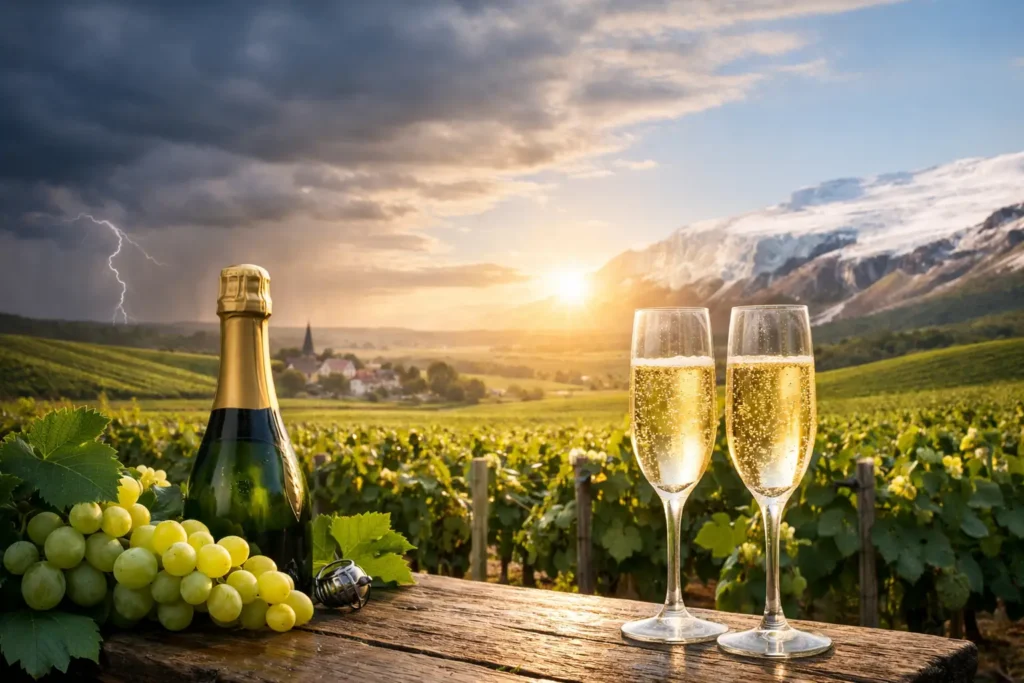
A harvest date in August would have sounded like a provocation in Champagne a generation ago. Now it is no longer shocking. That single shift tells you almost everything about climate change and champagne: the region is not facing an abstract future problem, but a present-tense transformation that is already visible in the vineyard, in the cellar, and in the glass.
For serious drinkers, this matters well beyond headlines. Champagne has built its identity on tension – low potential alcohol, bracing acidity, slow ripening, and the subtle complexity that comes from a marginal climate. When that climate changes, the region’s deepest stylistic assumptions are tested. The question is not whether Champagne can survive. It almost certainly can. The more interesting question is what kind of Champagne will define the next era.
Why climate change and champagne are now inseparable
Champagne was historically a cool-climate gamble. Vintages could struggle to ripen fully, and the house style of many grandes marques was designed around that reality. Blending across villages, varieties, and reserve wines was not merely artistry. It was insurance.
Warmer growing seasons have altered that equation. In broad terms, heat accelerates the growing cycle. Budbreak tends to come earlier, flowering can move forward, véraison follows suit, and harvest arrives sooner. The grapes often achieve higher sugar levels with greater consistency, while acids, especially malic acid, can fall more quickly.
That sounds favorable if your mental picture of Champagne is built around difficult, under-ripe years. In some respects, it is. Better ripening has helped reduce the green, austere edge that marked many weaker vintages in the past. Pinot Noir reaches fuller phenolic maturity more often. Chardonnay can show greater generosity. Pinot Meunier, long underestimated, can thrive impressively in warmer conditions.
But the gain comes with tension. Champagne does not want to become merely ripe sparkling wine. It needs luminosity, not just fruit. If sugar rises while acid retention drops, producers have to work harder to preserve precision, digestibility, and ageworthy structure. A richer base wine is not automatically a better one.
What warming changes in the glass
The most immediate effect of climate change and champagne is stylistic. Base wines from warmer years can look more complete and charming in youth, with riper orchard fruit, softer edges, and less of the stern citrus-and-chalk profile associated with leaner eras.
For some cuvées, that is a blessing. Non-vintage blends can achieve impressive harmony with less dosage than was once necessary, because the fruit arrives in the cellar with more natural generosity. This partly explains why lower-dosage styles have become more convincing across the region. The move toward Extra Brut and Brut Nature is philosophical, certainly, but it is also climatic.
Still, there are trade-offs. The finest Champagne depends on a particular kind of balance: moderate alcohol, high but integrated acidity, aromatic restraint, and a mineral line that keeps the wine airborne rather than broad. In hot years, fruit can edge toward tropical notes, alcohol can creep upward, and texture can become softer. The wines may impress early while raising questions about long-term definition.
This does not mean warm vintages are inferior. Some have been magnificent. It means the old markers of quality need finer interpretation. A generous, sunny profile may be thrilling in one terroir and slightly diffuse in another. A low dosage bottling may sing if the acid spine is intact and feel exposed if it is not. The region’s best growers and houses are no longer simply seeking ripeness. They are seeking freshness within ripeness.
Vineyard decisions matter more than ever
In the vineyard, adaptation is becoming the real frontier. Canopy management, once oriented primarily toward maximizing ripening in a cool region, now requires a more delicate hand. Growers need enough leaf cover to protect grapes from sunburn and excessive heat, yet enough airflow to limit disease pressure. Soil management also becomes more strategic. Living soils and thoughtful cover crops can help with water retention and root depth, though they must be balanced against competition in dry years.
Choice of site looks more important with every harvest. North-facing parcels, higher elevations, and cooler chalk-influenced locations may become more valuable in preserving acidity and aromatic finesse. This is where terroir starts to matter in an even sharper way. A site that once struggled to ripen may become ideal. Another that historically gave broad, generous fruit may tip too far in hot conditions.
Varietal balance may shift as well. Chardonnay remains central to the region’s most luminous expressions, particularly on chalk, but Pinot Meunier deserves more attention in this discussion. It has often been treated as the practical workhorse of the blend. Yet in certain sectors, it may offer resilience and strong results as weather patterns become less predictable. Pinot Noir, meanwhile, can produce extraordinary depth in warm years, though maintaining finesse becomes the challenge.
There is also the question of authorized but little-planted heritage grapes such as Arbane, Petit Meslier, Pinot Blanc, and Pinot Gris. Their role is still minor, and one should resist exaggerated claims, but renewed interest is understandable. Champagne has more genetic and historical diversity than the market sometimes remembers.
The growing risk is not just heat
It would be a mistake to reduce the issue to simple warming. Climate volatility may be even more disruptive than rising average temperatures. Earlier budbreak leaves vines more vulnerable to spring frost. Summer heat spikes can cause sunburn and shut down vine metabolism. Irregular rainfall patterns can swing a season from hydric stress to disease pressure with unnerving speed.
This is where simplistic optimism breaks down. Yes, Champagne has benefited in some years from better ripeness. But the region is also dealing with more extreme weather events, and extremes are difficult to manage in a wine region built on nuance. A steady, moderate warming trend might be relatively straightforward to adapt to. A pattern of sudden frost, summer heat, violent storms, and compressed harvest windows is another matter.
For large houses, scale offers certain tools. They can spread risk across many villages and rely on extensive reserve wine programs to stabilize style. For small growers, the stakes are more immediate. A single event can redefine the financial outcome of the year. Yet growers can also be nimble, making parcel-level decisions with remarkable precision.
Can Champagne keep its identity?
This is the question collectors and sommeliers care about most. If climate change continues to push Champagne toward greater ripeness, will the region lose the very profile that made it great?
The answer depends on what one believes Champagne’s identity truly is. If you define it narrowly as high-acid austerity, then yes, some classical signatures may soften. But if you define Champagne more deeply – as the union of chalk, blending intelligence, long élevage, autolytic complexity, and a singular equilibrium between vitality and finesse – then the region has room to evolve without surrendering its soul.
In fact, some of today’s most compelling wines suggest adaptation can sharpen quality rather than dilute it. Better raw material, picked at the right moment and handled with restraint, can produce Champagnes of striking purity. The danger lies not in change itself, but in overcorrection: chasing richness, losing tension, or treating easy ripeness as a substitute for precision.
That is why the most serious producers are reassessing every stage of production. Picking dates are more exacting. Pressing decisions become more crucial when fruit is naturally riper. Dosage is reconsidered not as a fashion statement but as a structural choice. Oak, reserve wines, malolactic conversion, and lees aging all take on slightly different weight when the base material has changed.
For readers who want to discover the world of champagne with real clarity, this is the period to taste comparatively. Follow the same producer across cooler and warmer vintages. Compare north-facing sites with broader, sun-soaked exposures. Watch how dosage interacts with ripeness. The conversation is no longer theoretical. It is already written into the bottles.
What the next chapter may look like
Champagne is unlikely to become static again. The region will continue to adapt, and the best estates will do what the best estates always do: read the season honestly rather than nostalgically. Some sites will rise in prestige. Some winemaking habits that once seemed fixed will look more conditional. Vintage character may become even more dramatic, not less.
There is also a broader cultural shift underway. Climate awareness is pushing many producers toward more sustainable viticulture, lower-impact farming, biodiversity, and soil health. Not every environmental claim deserves applause on first contact, and sustainability language can become marketing shorthand. Still, the underlying movement is real and overdue. In a region that trades on place, preserving place is not an optional ideal.
Champagne has always excelled at transforming limitation into style. That may be its great advantage now. The region was never defined by ease. It was defined by discipline, intelligence, and an almost obsessive pursuit of balance. Climate change raises the difficulty level, but it also clarifies what matters.
The bottles worth following in the coming years will not be the loudest or the ripest. They will be the ones that still carry lift, nerve, and quiet authority – the ones that remind you that even under pressure, true Champagne knows how to remain itself.