
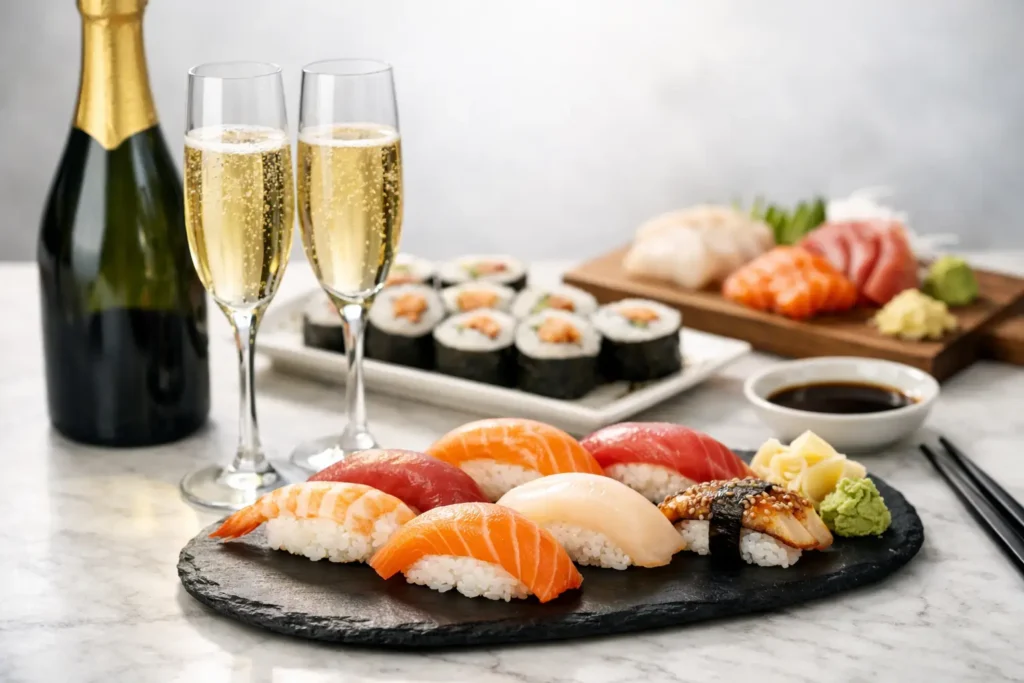
Sushi exposes weak pairings very quickly. The rice is lightly sweet and vinegared, the fish can be delicate or richly oily, soy adds salt, wasabi brings heat, and the texture is often more important than sheer flavor weight. That is exactly why the best champagne for sushi is rarely the biggest, toastiest, or most oak-driven bottle on the table. Precision matters more than power.
At its best, Champagne meets sushi on several levels at once. Acidity refreshes the palate after fatty tuna or salmon. Fine mousse lifts the texture of rice and cleanses away soy and umami. Chalky minerality mirrors the purity of raw fish. Yet there is no single answer, because sushi is not one dish. Hamachi nigiri, toro, uni, and spicy tuna rolls ask for very different things from a glass.
What makes the best champagne for sushi?
The strongest pairings tend to share three traits: high freshness, restrained dosage, and a relatively transparent expression of terroir. Sushi rewards clarity. When autolysis becomes too pronounced, or oak starts adding a layer of coffee, toast, or vanilla, the wine can overshadow the marine finesse of the food.
That usually makes Blanc de Blancs the most reliable starting point. Chardonnay from chalk-rich sites often brings citrus, white flowers, saline tension, and a vertical shape that flatters white fish, shellfish, and cleaner nigiri styles. Non-vintage cuvées with a crisp profile can be excellent. Vintage wines can also work beautifully, but only when maturity has not drifted into a broad, nutty register that overcomplicates the pairing.
This is also one of the few gastronomic settings where dosage matters a great deal. Brut Nature is not always ideal. With very pure sashimi it can be thrilling, but sushi rice contains sugar and vinegar, and a bone-dry wine may feel severe beside it. On the other hand, a softer Brut with moderate dosage often integrates better. Extra Brut is frequently the sweet spot.
Style first, producer second
Collectors often begin with house prestige, but sushi is a reminder that status and suitability are not the same thing. Some of the grandest Champagnes are simply too broad, too vinous, or too oxidative for the subtle architecture of Japanese cuisine.
A more useful approach is to think in styles. If you are choosing one bottle for a mixed sushi dinner, a high-class Blanc de Blancs or a taut, low-dosage Brut from a mineral house is the safest move. If the menu leans richer, especially into toro, salmon belly, or lightly torched preparations, you can move toward more structure, some Meunier richness, or even a serious rosé.
10 champagne’s for sushi
1. Salon Blanc de Blancs
For pristine nigiri and high-level omakase, Salon is one of the most exacting matches in Champagne. Its authority comes from tension, purity, and a laser-like chalk signature rather than overt weight. With sea bream, scallop, or hirame, it feels almost architectural. This is not the bottle for a sauce-heavy sushi night. It is for purity.
2. Jacques Selosse Initial
Selosse can be magical with sushi, but it depends entirely on the course. Initial has breadth, texture, and oxidative depth that can overwhelm delicate white fish, yet it becomes compelling with toro, uni, or soy-brushed eel. This is a pairing for drinkers who want intensity and are willing to trade some classic restraint for drama.
3. Pierre Peters Cuvée de Réserve
One of the smartest all-around choices. It offers the chalky precision and citrus lift that sushi loves, but with enough generosity to handle a broad range of nigiri and rolls. For many tables, this is closer to ideal than a rarer prestige cuvée because it remains vivid and composed without becoming too solemn.
4. Agrapart Terroirs Extra Brut
A connoisseur’s sushi Champagne. Agrapart brings incisive minerality, fine bubbles, and excellent cut, which makes it particularly strong with shellfish, squid, and white-fleshed fish. The Extra Brut profile feels measured rather than austere, so it can bridge sashimi and sushi rice with confidence.
5. Billecart-Salmon Brut Rosé
Rosé with sushi is often misunderstood. Many examples are too fruity or soft. Billecart-Salmon Brut Rosé succeeds because the red fruit is delicate, the structure remains graceful, and the finish stays dry enough for the table. It shines with salmon, tuna, and lightly spicy rolls. If the meal includes spice, this may outperform a stricter Blanc de Blancs.
6. Krug Grande Cuvée
Krug is not the universal answer, but it is brilliant with richer sushi. Think toro, unagi, mushrooms, or truffle-accented omakase courses. Its breadth, spice, and layered autolytic complexity can be too much for simple sashimi, but where the chef introduces umami and fat, Krug becomes a formidable partner.
7. Ruinart Blanc de Blancs
Refined, polished, and immediately charming, Ruinart Blanc de Blancs is excellent for entertaining where the menu ranges across classic nigiri, tempura elements, and lighter rolls. It has enough generosity to please a broad audience, yet enough freshness to preserve the integrity of the fish. It may not have the severe mineral drive some purists seek, but it is highly effective at the table.
8. Egly-Ouriet Les Premices
For sushi with a touch more richness, Egly-Ouriet can be superb. Les Premices carries more body and darker fruit than a lean Chardonnay-driven cuvée, but it remains energetic. This is a smart match for salmon, mackerel, and fuller-flavored pieces where a more structured Champagne feels welcome.
9. Charles Heidsieck Blanc des Millénaires
When mature Blanc de Blancs is handled at a high level, sushi can bring out its nobility. Blanc des Millénaires offers depth, silk, and length while preserving the Chardonnay line needed for fine pairing. It suits elevated omakase menus, especially when the chef moves from pristine white fish into richer shellfish and more complex seasoning.
10. Dhondt-Grellet Dans un Premier Temps
An insider’s choice with the kind of poise serious drinkers look for. This wine tends to deliver tension, finesse, and detail rather than brute impact. With nigiri, it feels quietly exact. It will not dominate the room, but at a thoughtful sushi counter that is often the point.
Pairing by sushi type
If your meal starts with sashimi, especially snapper, fluke, or scallop, stay with chalky Blanc de Blancs and lower oak influence. The fish is exposed, so the wine should be similarly transparent.
For classic nigiri, the rice changes the equation. A little dosage can help, and wines that are too severe may feel sharp beside the sweet-sour seasoning. This is where polished Brut or Extra Brut styles excel.
Fatty fish such as toro and salmon belly can absorb more vinous Champagne. Here, broader blends, some oak, or a more layered house style become assets. The same applies to uni, where texture and iodine can flatter Champagnes with depth and savory complexity.
Rolls are harder. Avocado, mayonnaise, tempura crunch, and spice can all blur the fine lines that make top Champagne so compelling. If rolls dominate the meal, especially spicy ones, a graceful rosé often performs better than a stern mineral wine.
What to avoid
Heavy oak is the first risk. Even great oak-aged Champagne can feel clumsy beside sushi if the wood signature is obvious. The second is excessive sweetness. Demi-sec is almost never the answer here.
The third is maturity without freshness. Older bottles can be extraordinary with certain umami-rich dishes, but if the wine has moved fully into mushroom, walnut, and deep toast, it can flatten the clean contours of the food. Prestige alone does not rescue a mismatched style.
Temperature also matters more than many hosts realize. Serve Champagne too cold and you mute texture and aroma. Serve it too warm and dosage, breadth, and mousse can become intrusive. For most sushi pairings, a cool but not icy pour allows the mineral and saline dimensions to show.
A practical buying approach
If you are buying one bottle for a sushi dinner and want the highest chance of success, choose a top Blanc de Blancs with moderate dosage and strong acidity. If you are planning a more expansive omakase, consider two bottles: a precise Blanc de Blancs for the opening sequence and a deeper, more vinous Champagne or refined rosé for richer later courses.
This is also one of those moments where grower Champagne can be especially rewarding. The best examples offer detail, salinity, and terroir transparency that feel naturally aligned with Japanese cuisine. That said, certain grandes marques remain exceptional at the table because their blending gives them calm, polished versatility.
Among experienced tasters at Champagne Club, sushi is often where stylistic nuance becomes easiest to see. The food is so exacting that every decision in the glass stands exposed – dosage, oak, autolysis, fruit profile, and texture all matter immediately.
Choose for the fish in front of you, not the label’s prestige, and sushi will return the favor by showing Champagne at its most refined.