
Explore Grand Cru Verzenay and discover the uncompromising nature of Pinot Noir and its architectural uniqueness. [ read the full champagne story ]
Estimated reading time: 23 minutes
It is an agonizing, almost physically painful truth that the modern wine world, in all its commercialized and pastel-colored vulgarity, has reduced Champagne to a fawning lifestyle accessory. For the average consumer – a creature whose palate has been systematically ruined by sweetened carbonated drinks, processed food, and a deeply rooted fear of anything that challenges the intellect – champagne is merely a symbol of instant, uneducated gratification. They scroll absentmindedly through the articl, oblivious to the fact that most of the bubbles they consume are as soulless as the standard flutes and wide coupes they mistakenly insist on serving them in.
But for those of us who dedicate our lives to deconstructing the bottled truth – we who without blinking pull the cork from between 2,500 and 3,000 bottles a year, who review hundreds of unique cuvées and whose inner soundtrack consists of the swirling strings in Bach’s Goldberg Variations, specifically Glenn Gould’s magical recording from 1981 – to us, the truth appears different. For us, there is a hierarchy, an indisputable aristocracy in the soil. And in this hierarchy, Grand Cru Verzenay rises like a monolith of coldness, structure, and intellectually demanding stringency. It is not a wine for the masses. It is a geographical and sensory slap in the face to mediocrity, a place where Pinot Noir is stripped of its inviting fruitiness and forced to display its naked, trembling skeleton.
The Geographical Arrogance: Turning Its Back on the Sun
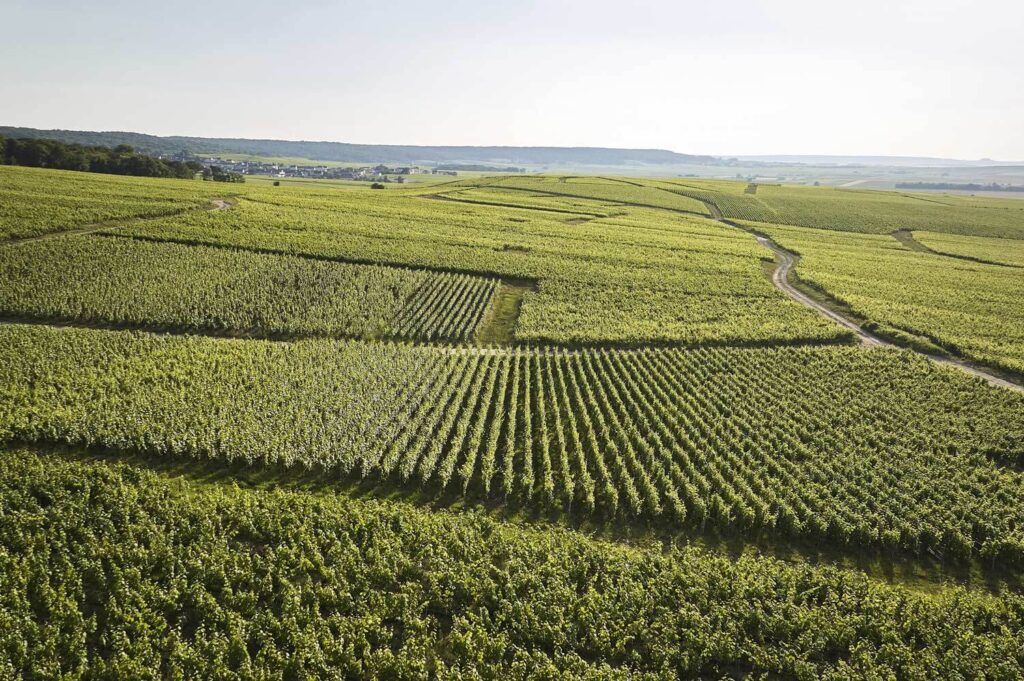
Let us consider the geographical absurdity that is Verzenay. In a wine region located on the very edge of what is climatically possible for viticulture, where every grower with self-respect and a pulsating bank debt begs the universe for a shred of southern sun exposure to save their frostbitten grapes from ruin, Verzenay demonstratively turns its back on the sun. This is not merely a topographical anomaly; it is a geographical arrogance of epic proportions.
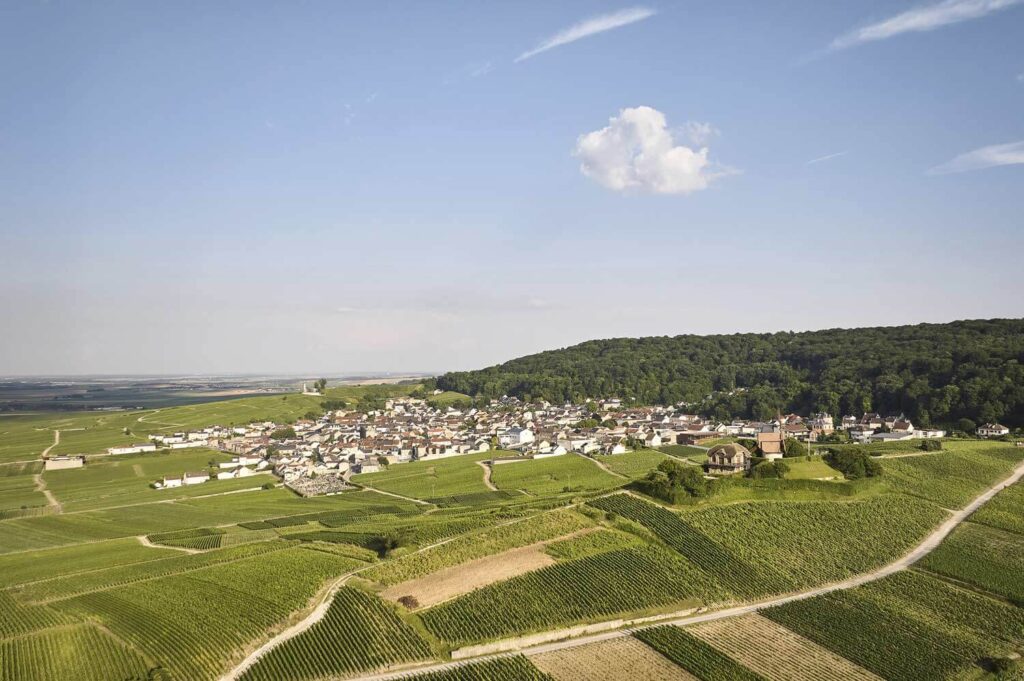
Verzenay is situated on the northern slope of the vast, forested plateau of Montagne de Reims. The village, which boasts roots stretching back to the 9th century , was one of the original three villages in all of Champagne to be elevated to the sacred status of Grand Cru, accompanied only by Cramant and Aÿ. Today, the village’s vineyards span approximately 420 hectares. The majority of these lands have a direct northern exposure, although the topography’s unique formations – often likened to the knuckles or fingers of an enormous glove reaching out towards the plain – offer subtle northeastern and northwestern variations on their respective slopes.
To plant Pinot Noir, the most neurotic, thin-skinned, and melancholic prima donna of grapes, on a windswept, north-facing slope is like placing an orchid in a freezer and expecting it to bloom. But it is precisely in this freezing stubbornness, in this barren darkness, that magic occurs. The grapes in Verzenay are notoriously slow to ripen; the village is almost without exception among the very last in the entire region to begin its harvest. This prolonged, agonizing phenolic maturation process is exactly what builds up the massive acidity levels and preserves a crisp, almost electrical tension in the fruit. Simultaneously, the constant, cool northern breeze acts as a natural fan that mercilessly blows away excess humidity, thereby drastically reducing the risk of botrytis and other fungal attacks that would otherwise decimate the crop.
The result of this cool exposure is a Pinot Noir (which constitutes nearly 90 percent of the plantings in the village ) that amplifies the bitterness and aggressive reactivity of the tannins. In the finished wine, this translates to a phenomenal backbone, an austerity that in its youth can appear almost hostile, but which conceals an aging potential that spans decades. These are wines with an introverted, reserved profile that demand years of silence in a dark cellar before they deign to reveal their full potential.
Architecture and Vanity: A Windmill and a Lighthouse in a Sea of Wine
No analysis of Verzenay – or of human nature’s inherent propensity for the absurd – is complete without contemplating the village’s two iconic, almost comical landmarks. On the hills marking the village’s opposite extremes stand two monuments to both stubbornness and shameless commercialism: Moulin de Verzenay (the windmill) in the north and Phare de Verzenay (the lighthouse) in the south.
The history of these buildings is as fascinating as it is tragicomic in the context of European warfare. It is a thoroughly remarkable, dark paradox that almost every stone in the residential and commercial buildings in Verzenay was completely destroyed during the mechanized slaughterhouse of the First World War – to the point that only a broken 50 hectares of vineyards remained under active cultivation – yet both the windmill and the lighthouse were left standing. They stood there, completely intact, even though the bloody trenches of the frontline were barely a mere kilometer away. It is as if the war machine itself paused to admire the absurdity of the landscape.
The lighthouse, in particular, carries a history that warms a cynical heart. To erect a lighthouse on a hill in the middle of a wine region, hundreds of kilometers from the nearest sea, is an act of pure, unadulterated hubris. It was built in 1909 by Joseph Goulet, a man whose ambition was only surpassed by his flair for marketing, exclusively as a gigantic, vulgar billboard for his newly created champagne brand. As one of the absolute first buildings in the entire region constructed from reinforced concrete, it was raised over the vineyards bearing his name in giant letters. In the evenings, the lighthouse’s rotating lantern was turned on, and its beam of light swept across the hills of Verzenay, so powerful that it could be seen all the way to the cathedral city of Reims.
During what the French call “Les Années Folles” (the Roaring Twenties), the site at the foot of the lighthouse was transformed into a decadent hub of amusement. A restaurant, a theater, and a popular “guinguette” (a traditional outdoor bar with dancing) were erected in the annex buildings. It became an inevitable gathering place for the bourgeoisie from both Reims and Épernay, whose journey was facilitated by the now-defunct CBR railway (Compagnie des Chemins de Fer de la Banlieue Rémoise) that then serviced Verzenay.
But the party is never eternal. During the Second World War, this monument to pleasure and advertising was degraded to a simple military observation tower. This time, the lighthouse was fired upon mercilessly, its annex buildings were razed to gravel, and only the reinforced concrete core withstood the fire. After the war, it was left to rot, abandoned and swallowed by vegetation for almost forty years, before the municipality, in a rare moment of historical awareness, bought the ruin in 1987. Today it serves as an ecomuseum, where whoever bothers to drag their carcass up the 101 steps to the belvedere is rewarded with a 360-degree view over the fields where the Pinot Noir grapes silently fight their eternal battle against the elements. It is a fitting, almost poetic metaphor for Verzenay: that which was initially built to be seen, to dominate, and to sell, stands today as a quiet, scarred survivor watching over the region’s absolute finest fruits.
The Subterranean Violence: Erosion, Chalk, and Clay
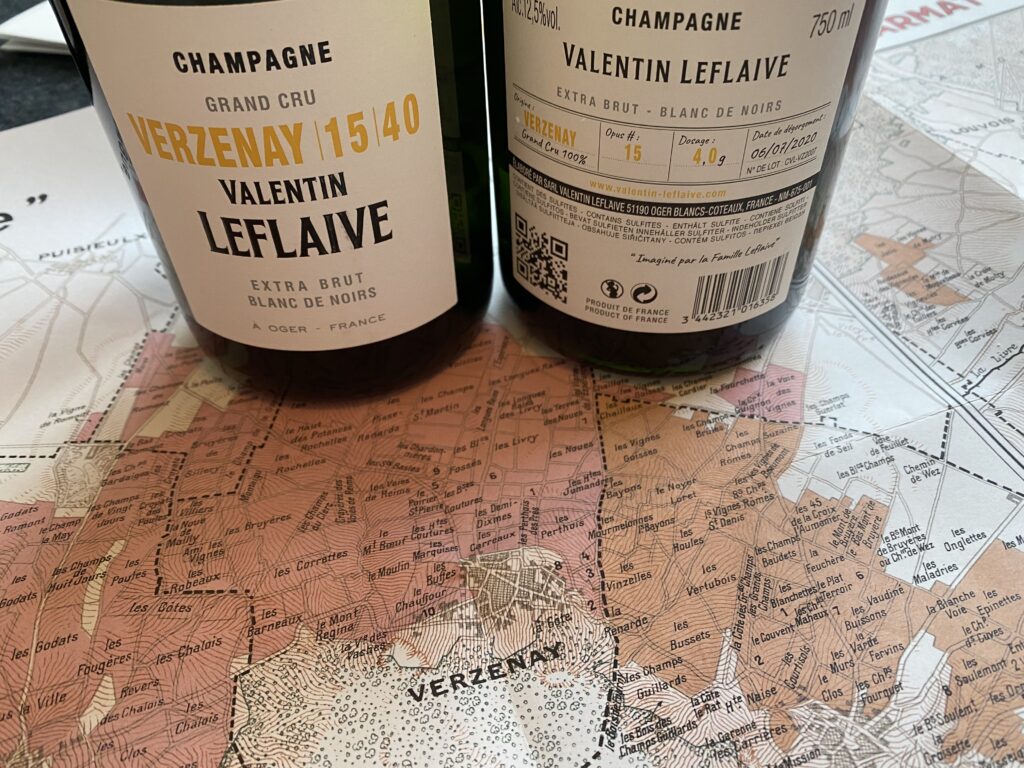
To fully comprehend the greatness of Verzenay’s wines, one must abandon the romance of the grape harvest and instead dig one’s well-manicured hands deep into the dirt. Viticulture at this level is not romance; it is geological warfare. Verzenay’s terroir is of a rare and violent complexity, and its austere, intellectual profile cannot be deciphered without a rigorous and unsentimental analysis of its subterranean architecture.
The entire sector constitutes a geological anomaly. The vineyards in the village display a relatively steep slope – by far the most significant inflection on the entire Montagne de Reims – with an elevation drop that brutally stretches over nearly 2.8 kilometers, from 230 meters of altitude down to 110 meters above sea level. This dramatic, unforgiving slope has been the stage for enormous, relentless erosion over millions of years of geological epochs.
This erosion has not only moved soil; it has restructured the bedrock itself. The chalk in the subsoil has been subjected to pressure and abrasion that caused it to recrystallize and harden into an extremely compact, hard substance, a form of chalk cover (often referred to as Campanian chalk) that is remarkably less porous than the chalk found in, for example, the Côte des Blancs. This rock-hard chalk is particularly prominent up on the crests, right at the altitude where our two friends, the lighthouse and the windmill, stand positioned on their respective promontories.
Simultaneously, the constant flow of water and time has acted as a giant, geological sieve. The clayey silt has been mercilessly washed from the hilltops and flushed downwards towards the valleys and plains. The soil on the lower slopes (where many of the most complex vineyards are located) therefore consists of a fine, dense clayey colluvium mixed with this washed-down erosion silt. On the top of the hills, the thin topsoil touches directly upon the hard chalk, while the soil becomes progressively deeper and more clay-rich the further down into the hollows of the valleys one moves.
What does this subterranean geography mean for the poor vine? It means a daily, masochistic struggle for survival. The vineyards’ root systems are forced to penetrate two entirely distinct horizons to find nourishment, a task requiring enormous physiological effort from the plant:
This duality – the clayey power above and the chalky electricity below – is the very core of Verzenay’s superiority. It is a balancing act between raw strength and intellectual sharpness that no other village in Champagne can replicate.
| Geological/Topographical Parameter | Specification in Verzenay | Sensory Effect on Pinot Noir |
| Exposure | Mainly North, Northwest, Northeast | Slow phenolic ripening, preserved high acidity, nervy tension, pronounced and reactive tannin structure. |
| Altitude & Slope | 110m to 230m above sea level (2.8 km slope) | Excellent natural drainage, minimized risk of rot and fungal attacks in cool vintages. |
| Topsoil (Colluvium) | Clayey silt, transported via erosion | Massive vinous power, dark berry intensity, notable body, and full texture. |
| Subsoil (Bedrock) | Hardened, crystallized Campanian chalk | Surgical precision, high salinity, mineral electricity, and prolonged “vibration” in the finish. |
The Cold Intellect of Pinot Noir
Let us thus speak of the fruit itself. To fully appreciate Verzenay, the consumer must mentally detach themselves from the conventional, tiresome notion of Pinot Noir as solely a purveyor of lush, accessible, and sweet red fruit. If you seek a vinous security blanket, turn your gaze elsewhere.
Pinot Noir from the southern Côte des Bar, which grows on Kimmeridgian marl (the same geological formation as in Chablis), certainly provides charming, round, and fruity wines with softer acidity and notes of strawberries and approachable spices. Villages like Aÿ or Bouzy, which drink deeply of the southern sun’s rays, offer in turn a massive, broad-shouldered body and sun-ripened warmth that fills the entire palate.
But Verzenay, ah, Verzenay represents the grape’s cool, razor-sharp intellect. Here, where the grape accounts for nearly 90 percent of all plantings , the expression is completely different. The sensory landscape of a classic Blanc de Noirs (a white wine pressed exclusively from these black grapes ) from Verzenay is characterized by an immediate, almost aggressive attack of nervous energy. The nose is rarely lush; rather, it is marked by incense, crushed rocks, wet stones, and cool, autumnal tones of yellow fruits like quince, rhubarb, and medlar. With time in the glass – and this wine demands time – more traditional markers of dark cherries, black raspberries, violet, and apricot emerge.
On the palate, the wines are rarely broad. They are instead ramrod straight, linear, and driven by a pronounced salinity and an almost distilled purity that makes the saliva rush. The soaring acidity acts as a tightly laced corset holding the fruit in an iron grip. A constantly recurring signature of mature Verzenay Pinot Noir is its deeply pronounced umami character. Notes of roasted almond, hazelnut, freshly baked sourdough bread, and even hints of dried meat and iodine accompany the fruit profile, creating incredible depth and giving the wines a gastronomic wingspan that outclasses almost everything else in the region.
The Corporate Giants and Peasant Gold: Grandes Marques
It is no secret that the large, multinational champagne houses – the so-called Grandes Marques – have for centuries used Verzenay’s grapes as a fundamental, load-bearing steel structure in their most prestigious and complex cuvées. They need the village’s icy spine to ensure their non-vintage blends do not collapse into a flabby mess of overripeness.
Bollinger: The Architecture of Decadence and the PN VZ Series
Consider Champagne Bollinger. Universally – and rightfully – recognized as the definitive “Pinot Noir house,” whose heavy, oak-aged style has been the favorite of British aristocrats (and fictional spies) for generations. Bollinger has historically used Verzenay as a counterweight to the enormous, oxidized power of their own vineyards in Aÿ. But with the launch of their relatively new PN series, the house’s management, under CEO Charles-Armand de Belenet and cellar master Denis Bunner, has made the brilliant decision to isolate and highlight individual villages.
Their release PN VZ19 is a masterpiece of controlled brutality. The wine is a 100 percent Pinot Noir (Blanc de Noirs) where the base vintage is 2019, and where the lion’s share of the grapes (50%) is sourced exclusively from Verzenay, with smaller proportions from Aÿ, Tauxières, and Avenay to provide facets. Building a wine around the hot 2019 vintage is risky, but Bunner skillfully balances this with a full 48 percent reserve wines, a significant portion of which has been aged in magnums under natural cork, stretching all the way back to the 2009 and 2008 vintages.
More than 50 percent of the must for PN VZ19 is vinified in oak barrels , a signature for Bollinger that gives the wine its breadth, and the wine has been resting on its lees for over four years – more than twice as long as the appellation’s rules stipulate. With a moderate dosage of 6 grams per liter , disgorged in March 2024 , the wine delivers an almost shocking complexity. The structural salinity and the chiseled acidity from Verzenay cut straight through Bollinger’s trademarked decadence. It opens with a powerful nose of apple, rhubarb, hazelnut, fig, and mirabelle plum, which on the palate transitions into blood orange, cherry fruit, rosehip, and a deep, marine note of iodine and jasmine before landing in a secure, infinite finish of umami. It is a wine that de Belenet very aptly describes as “endlessly decadent”.
Krug: The Cathedral-like Framework of Maximalism
If Bollinger is decadence, Champagne Krug is pure, unadulterated maximalism. In Krug’s masterpiece, their annual Grande Cuvée (let us here focus on the magnificent 168th edition), Pinot Noir forms the dominant force at 52 percent (followed by 35% Chardonnay and 13% Meunier). Krug’s philosophy is operatic; each bottle is a blend of over 120 distinct wines sourced from more than 10 different vintages, which are then forced to integrate during a full seven years of maturation in the cellars before the golden label is finally attached.
For such a monumental construction not to collapse under its own weight of barrel aging, maturation, and oxidized tones, a foundation of improbable strength is required. This is where Pinot Noir from villages like Verzenay steps in. They act as the steel pillars in a Gothic cathedral; they are not always visible to the naked eye, but without them, the entire structure would crumble into an unstructured ruin of dried fruit and caramel.
G.H. Mumm: Historical Ties and RSRV
The house of G.H. Mumm bears perhaps the deepest historical tie of them all to the village. They acquired their very first vineyard in Verzenay in 1840, and had the fruit pressed there in their first own press house, purchased three years later, in 1843. This deep, almost genetic connection is manifested today in their rare Mumm RSRV Blanc de Noirs, a prestige cuvée created exclusively from Grand Cru Pinot Noir from Verzenay.
The 2018 release, dosed at 6 g/l and disgorged in May 2023, is a brilliant, albeit more toasted, example of how the terroir expresses itself in a warmer year. The pale, gold-reflecting liquid rises from the glass with initial smoky notes, baked apples, spicy pears, buttery croissants, and vanilla. This almost pastry-like introduction then transitions on the palate into a taut, complex attack of quince marmalade, candied fruit, and an incredibly powerful, umami-driven taste of sourdough, before the wine pulls together and finishes with the village’s typical iodine-saturated, saline nerviness. Even in the house’s flagship Cuvée René Lalou (exemplified by the 2008), the power of Verzenay is utilized in symbiosis with the elegance of Cramant and Avize to create an aristocratic, feather-light yet deeply resonant champagne.
| Producer & Cuvée | Type & Basic Facts | Cellar Aging & Barrel Philosophy | Terroir & Sensory Profile |
| Bollinger PN VZ19 | Blanc de Noirs (100% PN). Base year: 2019. | >4 years on lees. >50% oak barrels. Reserves back to 2008. Dosage: 6 g/l. | Dominance from Verzenay. Mirabelle plum, roasted hazelnut, fig. Decadent power with taut salinity and acidity. |
| Mumm RSRV Blanc de Noirs 2018 | Blanc de Noirs (100% PN). 100% Verzenay Grand Cru. | Historical heritage from 1840. Dosage: 6 g/l. Disgorged: May 2023. | Yellow fruits, vanilla, brioche, candied fruit. Powerful umami (sourdough) with a pronounced iodized/saline finish. |
| Krug Grande Cuvée (168th) | Blend: 52% PN, 35% Chard, 13% Meunier. | >120 wines from 10+ vintages. 7 years aging on the lees. | Monumental, oxidized style where Verzenay’s Pinot Noir acts as an invisible, backbone-providing steel framework. |
| Valentin Leflaive Verzenay 20|3.0 | Blanc de Noirs (100% PN). Base year: 2020. | Steel and oak barrels (vinified separately). 31 months aging. Dosage: 3.0 g/l. | >50-year-old vines, clayey silt over chalk, northern exposure. Fruity and minerally razor-sharp Extra-Brut. |
The Fanatics of the Soil: The Avant-Garde of Grower Champagne
While the large houses use Verzenay as one of many brushes on their massive canvas, it is among the small, independent growers (Récoltant-Manipulant, RM) that the village’s true, unfiltered soil is dissected with analytical, almost fanatical sharpness. It is here we find the true zealots. [1][2]
Pehu-Simonet: The Surgical Purism
At the forefront of this movement, we find David Pehu of Pehu-Simonet. He is a master of both paradox and unbending purism. With a total of merely 5 hectares of vineyards, primarily concentrated in Verzenay and other Grand Cru villages, Pehu works based on organic principles to force the ultimate truth out of his soil. Historically, Pehu belonged to the extremely orthodox faction that categorically refused to allow malolactic fermentation (the process that converts sharp malic acid to softer lactic acid) in his wines, all to preserve the wines’ maximum, almost painful tension. He has admittedly become marginally more pragmatic over time , but his wines still balance on the edge between an earthy, almost rustic origin and an extreme, glossy refinement, often characterized by a massive umami character and non-existent or very low dosage.
His series Fins Lieux (which fittingly translates to “Fine Places”) constitutes an in-depth masterclass in Verzenay’s shifting microclimates. Let us examine two of his most fascinating bottlings from 2016:
Jean Lallement et Fils: The Traditional Primal Force
If David Pehu is the surgeon, the Lallement family – represented today by Jean-Luc and Paula-Alexandra Lallement – are the village’s traditional stonemasons. They have a history of selling their own wine that stretches back to the aftermath of the price crash of 1929.
Their philosophy rests on an almost reactionary refusal to manipulate the must. In an era where wineries resemble clinical laboratories, Lallement works according to ancient principles. The grapes are harvested exclusively by hand with pedantic attention to ripeness and pressed immediately on the estate. The vinification itself occurs with shocking minimalism: no added yeast (levurage), no form of filtration and, remarkably enough, no artificial cooling. The must is allowed to live its own life; the wine is instead racked (soutirage) repeatedly during the year and allowed to rest in tanks right up until July before bottling, a process that loads the liquid with massive, unpolished aromas straight from its own lees.
Besides their excellent Brut Tradition (a classic blend of 80% Pinot Noir and 20% Chardonnay, dosed to a taut 6 g/l) , it is their solitary interpretation of the Les Perthois plot that commands the deepest respect. Lallement’s Les Perthois Blanc de Noirs (see the 2019 vintage) is 100 percent Pinot Noir vinified exclusively in oak barrels. Where Pehu seeks steel and crushed rock in the same vineyard, Lallement coaxes out Verzenay’s brutal, deeply resonant body. It is a wine bursting with red fruits, supported by a round, meaty power that is nevertheless disciplined by the village’s uncompromising acidity. It is old-fashioned, unadulterated champagne that despises the modern world’s demand for polished compliance.
Henriet-Bazin: Empathy, Gravity, and Respect
To add yet another dimension of dedication, we must consider Champagne Henriet-Bazin. Nicolas and Marie-Noëlle constitute the fourth generation at this estate, which encompasses 7.75 hectares of vineyards, significant portions of which are scattered across the lower slopes of the “glove fingers” in Verzenay and the neighboring village of Verzy. Since the early 2000s, they have embraced a deeply emotional philosophy that they summarize in a single imperative: Respect.
This is not the comfortable “sustainability” (Viticulture Raisonnée) that many houses hide behind. It is a total surrender to nature. By completely banning herbicides, integrating grass cover crops, and strictly following the lunar cycles, they have literally reawakened the earth. As a direct result, the root systems of their vines have been forced to change behavior; to survive, they are forced to drill infinitely deeper into Verzenay’s hard chalk. The work inside the winery is exactly as passive and respectful; all movement of the precious must occurs using gravity without mechanical pumps that stress the wine, no filtration is applied after natural decanting (débourbage), and the wines are left to rest a full 9 months in enameled steel tanks before Marie-Noëlle begins her dazzling blending work.
This minimalist non-intervention allows her to chisel out the details from the family’s 36 parcels with an artist’s sensitivity. Their blends are aged for a minimum of three years in the cellar, vintage wines for over six years. The purpose, according to the estate itself, is for the consumer to physically feel the connections to the earth and perceive the “vibrations of the rock” in the glass. A more intellectual, almost spiritual definition of the Verzenay terroir is hard to find in modern times.
The Urban Forest and Absolute Ripeness
That Verzenay acts as a magnet for deep thinking and uncompromising winemakers is also proven by actors like Sébastien Mouzon (Mouzon Leroux) and the couple Petit & Bajan.
Sébastien Mouzon has been a pioneer in what is now called vitiforestry. In direct defiance of centuries of monoculture, he has, together with like-minded growers, planted over 5,000 trees directly in the vineyards in and around Verzenay and Verzy. These trees, of varying heights, are strategically placed to cast necessary shade over the vines during the increasingly hot vintages brought about by the climate crisis, creating a richer, more resilient ecosystem. Through rigorous soil analyses, Mouzon has documented how the land shifts from Verzy’s dominant silex (which yields sharp, sparkling minerality) to Verzenay’s richer clay soils, which invariably generate the most massive and muscular expressions of Pinot Noir on the entire mountain.
At Domaine Petit & Bajan, run by Richard Petit (native to the Chardonnay stronghold of Avize) and Véronique Bajan (with deep roots right in Verzenay), a philosophy deeply rooted in the legacy of their friend and mentor Anselme Selosse is applied. With just over five acres of land in Verzenay, they have a single unforgiving rule: the fruit must be completely, absolutely ripe before harvest. In a region characterized by a fear of rot, their patience often results in the fascinating spectacle where most other conventional growers in the village have already finished harvesting and cleaned their presses for the season before Petit & Bajan have even lifted a pair of secateurs. Their reward is incredibly bold, aromatically explosive, and deeply vinous Grand Cru champagnes that completely reject any notion of frivolity.
| Grower (RM) in Focus | Area & Focus in the village | Unique Winemaking Philosophy / Methods | Signature Expression / Key Cuvée |
| Pehu-Simonet | 5 ha total, dominant Grand Cru Verzenay. | Variable malo practices. Low dosage (1.5g/l). Often 100% barrique. Long aging. | Analytical, crisp purism. Extreme expressions in Fins Lieux #1 and #2. |
| Jean Lallement | Small-scale Grand Cru Verzenay. Family-owned since 1930. | Zero added yeast. Zero filtration. Zero cooling. Racking. Oak barrel fermentation. | Meaty, traditional, unpolished power. Unyielding fruit drive in Les Perthois Blanc de Noirs. |
| Henriet-Bazin | 7.75 ha total (many plots on lower slopes). | Ecological empathy. Lunar cycles. Gravity winery. Enameled vats. Long aging. | Finesse and vibration. Harmonious blend of Verzenay and Verzy. “Vibration of the rock”. |
| Petit & Bajan | 5 acres Grand Cru Pinot Noir in the village. | Extreme harvest criteria. Harvests extremely late to achieve maximal phenolic ripeness. | “Selosse”-inspired intensity. Bold, deeply aromatic, and vinous wines. |
| Mouzon Leroux | Parcels on the border with Verzy. | Vitiforestry (planting of over 5000 trees in the vineyards). Ecosystem balance. | Surgically separates Verzy’s silex minerality and Verzenay’s clayey raw power. |
We should also not forget other actors carrying the village’s banner, such as Michel Arnould & Fils whose impressive 12 hectares deliver wines like the razor-sharp Cuvée Acuité and the darkly intense, macerated Saignée 2020 , or Rousseaux-Batteux and Louis Dousset who with unconventional brilliance continue to prove that Verzenay is a playground for the most untethered minds in the wine world.
The Climatic Apocalypse and The Last Outpost
All of this – the barren land, the history, the winemakers’ obsession – points towards an inescapable fact. As the merciless scourge of global warming forces temperatures upward, Champagne’s geopolitical wine map is being redrawn forever.
The historically so cherished, scorching hot south slopes in villages like Bouzy and Aÿ, which for centuries have guaranteed ripeness in an otherwise freezing climate, now risk turning into ovens. There, the fruit threatens to overripen, the acidity evaporates in the summer sun, and the wines tend to adopt a flat, jammy, and alcohol-heavy character that robs them of all form of finesse.
In this approaching climatological inferno, it suddenly becomes crystal clear that Verzenay’s once questioned, averse northern placement is no longer a challenge to be overcome, but the village’s absolute greatest, most invaluable, and future-proof asset. With its built-in coolness, its slow ripening, and its fanning winds, Verzenay indisputably emerges as the last, cool outpost. The analysis is ruthless but clear: it is here, on these windswept, clayey slopes under a scarred lighthouse body of concrete, that the future’s uncompromising, intellectual Blanc de Noirs will be forced to be defined.
Epilogue: On Ritual and Respect
How, then, does one consume a wine that demands so much of its beholder? First, throw out the damned standard flute and the vulgar, flat coupes that belong at a wedding for people without taste. A great wine from Verzenay demands the volume of a bowl, a glass that lets the heavy fruit breathe and captures the subtle umami notes without dampening the electrical acidity. A Riedel glass, preferably with the same precision as the one created for Dom Pérignon , or a bowl from Richard Juhlin’s collection , is not a luxurious addition but an absolute minimum requirement.
And for God’s sake, do not serve it ice cold. To drink a Bollinger PN VZ19 straight out of an ice bucket is to commit physiological murder against its roasted hazelnuts and apricots; 10 to 11 degrees Celsius is the exact interval where its architecture is allowed to flourish.
A wine from Verzenay is not meant for lighthearted toasts on a sunny outdoor terrace. It is a wine that requires the gastronomic weight of a well-aged Comté, dried fruit, white poultry, or why not Swedish lobster. It is the beverage equivalent of an intellectual dispute; it demands commitment, it demands time, and it requires a certain measure of experience to even be understood.
For the insouciant consumer looking for a quick, sugar-laden intoxication, there are miles of shelves of mediocre alternatives available with a quick click online. But for the initiated, for the one who understands that true beauty is often born out of suffering, struggle, and an uncompromising refusal to bow to the mundane – for us, Verzenay is not just a geographical place on a label. It is the very quintessence of Pinot Noir in its most naked, unassailable, and magnificent form. Let the others drink their sweet bubbly water; we will keep the darkness, the clay silt, and the trembling chalk for ourselves.