
Exclusive for Champagne Club by Richard Juhlin [ read the full champagne story ]
Estimated reading time: 5 minutes
My friends, if Champagne were a dinner party, the grand houses would be the boisterous guests doing parlor tricks in the drawing room, while the serious business of actual gastronomy would be quietly taking place in the kitchen. And if you want to find the culinary equivalent of a Michelin-starred service in the Côte des Blancs, you don’t look for neon signs; you look for 4 rue de la Brèche d’Oger.
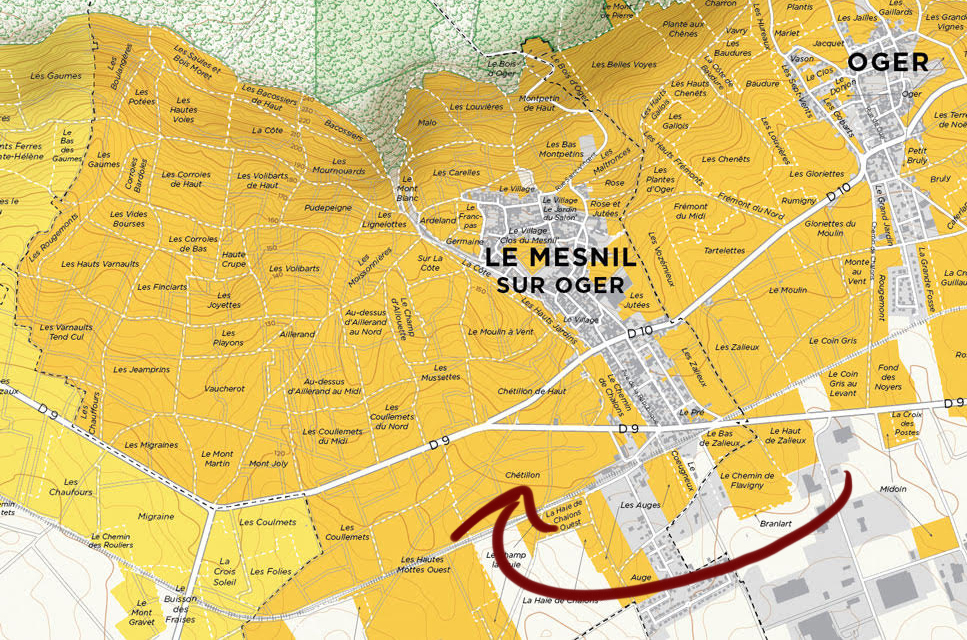
This is Le Mesnil-sur-Oger. Just saying the name feels like you should be wearing tweed and a sneer. It is the absolute, uncompromising heartland of Chardonnay. Here, opposite Salon and a stone’s throw from Krug’s Clos du Mesnil , you will find Guy Charlemagne, a Propriétaire Récoltant making wine since 1892. Today, the estate’s destiny is presided over by the fifth generation, sisters Justine and Marie Charlemagne. They are quietly orchestrating some of the most profound, nerve-tingling Blanc de Blancs on earth. And their crowning glory is the mythical lieu-dit of ‘Les Chétillons’.
The Dirt and the DNA
The Charlemagne estate cultivates nearly one hectare of this revered terroir. It is divided into four owned plots —two located in ‘Les Chétillons de Haut’ and two in ‘Les Chétillons’ proper. The vines here are venerable, ranging from 35 to 56 years of age, entirely propagated through massal selections planted in 1970, 1979, 1984, and 1991.
They face South and East, bathing in the sun while their roots claw through the outcropping chalk. It is this naked limestone and minerality that gives the wine a spine of pure steel.
The Tyranny of the Cork
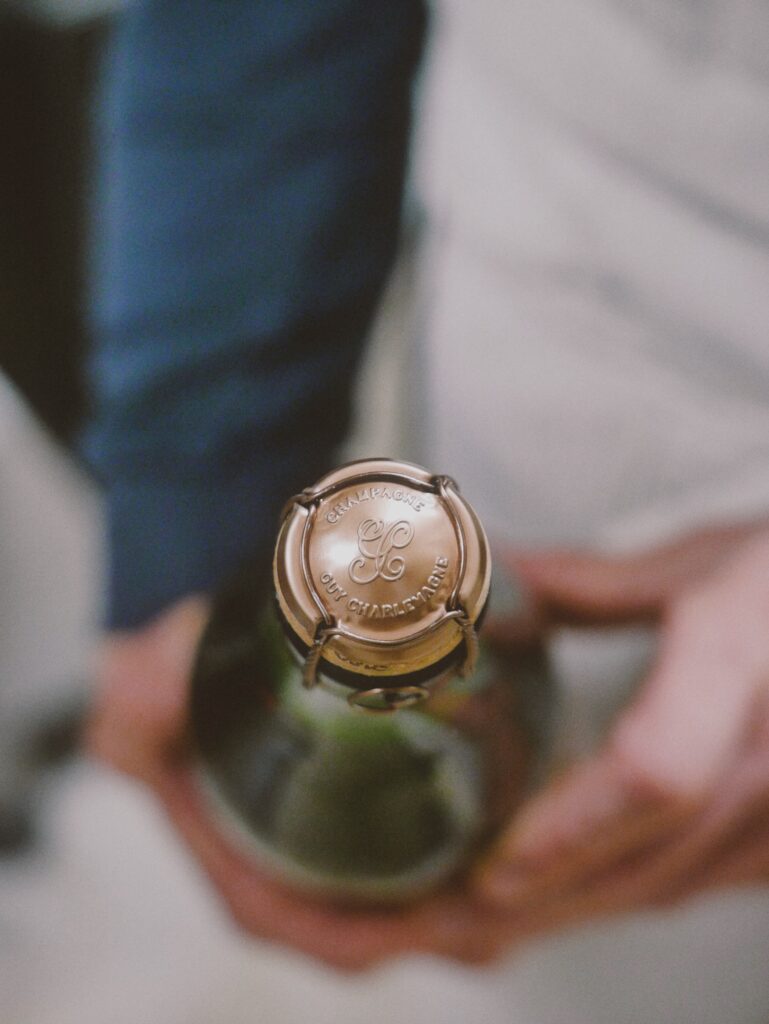
What truly separates Les Chétillons from the mediocre fizz of the masses is the cellar philosophy. First, there is absolutely no malolactic fermentation (100% blocked). But more importantly, since the 1988 vintage, this cuvée has been aged exclusively tiré bouché liège—under a natural cork with a traditional square lip (bague carrée) rather than a cheap metal crown cap.
Why bother with the arduous, manual labor of cork? Because a crown cap is for people in a hurry. The cork releases far less oxygen during the excruciatingly long aging on the lees. This deliberate, slow maturation magnifies the wine’s reductive style, coaxing out seductive, smoky, grilled, and toasty notes. It amplifies the texture, transforming the liquid into something rich, deep, and impossibly silky. It allows the wine to develop a profound patina without ever losing its violent, youthful energy.

The 2012: The Phoenix of a Vicious Year
This year, the estate is releasing the 2012 vintage—and for the very first time, it is available in a standard bottle format.
The 2012 vintage was, quite frankly, a meteorological paradox. It threw everything at the vines: spring frost, torrential rains, and brutal mildew attacks, leading to agonizingly low yields. The grapes were finally hauled in on September 20.
After spending a monumental 12 years on its lees (bottled in February 2013 and disgorged in May 2025) , only 2,000 bottles were produced. Finished with an Extra-Brut dosage , the nose is an onslaught of elegance and aromatic intensity, dripping with reduction, dried fruit, biscuit, almond, and a peculiar hint of green tea. In the mouth, it is fiercely vertical and precise, characterized by an exceptional concentration and a positive, mouth-watering bitterness.
The 2008 Magnum: A Ghost from the Wine Library
For the true obsessives, the Charlemagne sisters have unlocked their ‘Collection Privée’ to release the 2008 vintage, exclusively in magnum.
The 2008 season was famously cool and dry, devoid of heatwaves, resulting in a painfully slow and even ripening process. This magnum has slumbered in the dark for 16 years on its lees (bottled January 2009, disgorged May 2025). Only 256 magnums exist. The tasting experience is an exercise in subtle elegance; it possesses a toasted reduction, soaring verticality, and a finish of infinite length on the palate.
Marie Charlemagne puts it perfectly: it is the harmonious collision between the brute energy of the terroir and the finesse of that smoky patina.
Do yourself a favor. Smash your flutes, pour this into a proper Burgundy glass, and taste what Chardonnay is actually supposed to be.