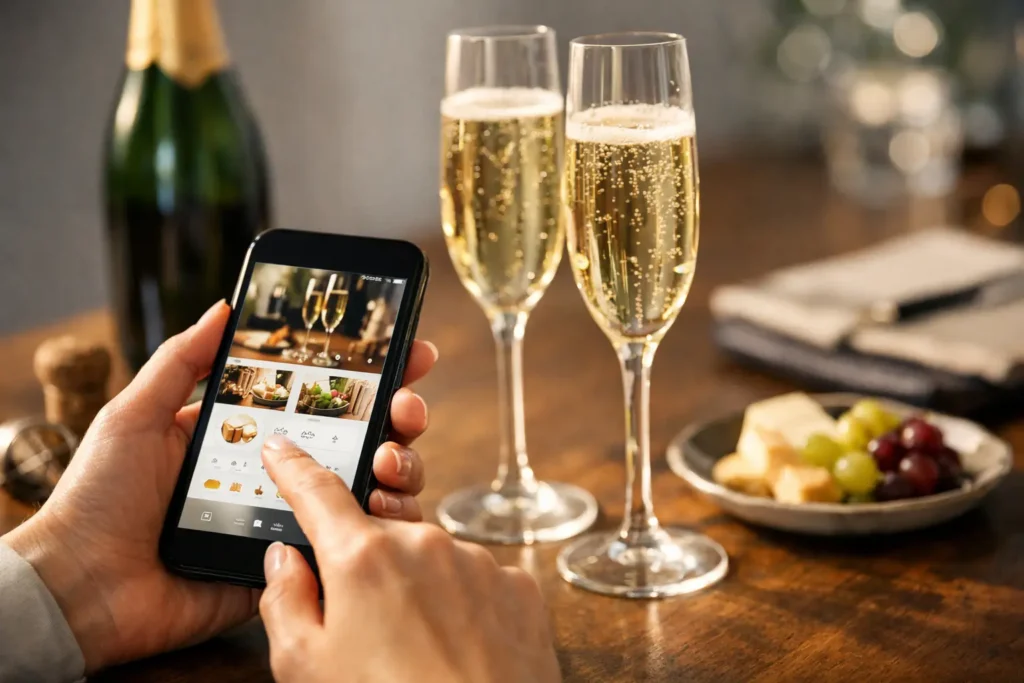
- Champagne Club app: https://apps.apple.com/us/app/champagne-club/id1527100676
- Champagne Club app: https://play.google.com/store/apps/details?id=com.champagneclub.champagne&hl=en&pli=1
A great bottle rarely fails in the glass. What fades is the memory of it. You remember the tension, the chalk, the sudden bloom of orchard fruit, but not always the exact disgorgement, the food pairing, or why one grower wine felt more alive than another. That is where a champagne app for tasting notes stops being a convenience and starts becoming part of serious tasting discipline.
For casual drinkers, an app can function as a pleasant record. For collectors, sommeliers, and committed enthusiasts, it should do much more. Champagne is unusually dependent on detail. Producer philosophy matters. Base vintage matters. Dosage matters. Disgorgement matters. A note that ignores those variables may be fine for social sharing, but it is less useful when you are deciding whether to rebuy a bottle, compare releases, build a cellar, or track a producer over time.
What makes a champagne app for tasting notes worth using
Most wine apps are built for breadth. They want to cover every region, every variety, every price point, and every user type at once. That can be practical, but Champagne is not a category that rewards superficial organization. If you are tasting across non-vintage blends, prestige cuvees, single-vineyard wines, and older disgorgements, you need more than a star rating and a photo of the label.
A strong champagne app for tasting notes should first help you identify the wine correctly. That sounds obvious, yet it is where many platforms fall short. Producer names are often duplicated, cuvees are entered inconsistently, and release-specific details can disappear into generic listings. For still wine, that may be mildly annoying. For Champagne, it can make a note almost useless.
Depth of producer context is the next dividing line. The best notes do not float in isolation. They sit inside a broader framework that helps you understand style, village identity, winemaking choices, and historical consistency. If an app lets you log your impression of a Blanc de Blancs but gives you no meaningful producer background, you are recording a moment without building knowledge.
Searchability matters just as much. You should be able to retrieve notes not only by producer and cuvee, but also by vintage, dosage style, grape mix, village, or occasion. The more serious your cellar becomes, the more this matters. A private archive is only valuable if it can be interrogated later.
- Champagne Club app: https://apps.apple.com/us/app/champagne-club/id1527100676
- Champagne Club app: https://play.google.com/store/apps/details?id=com.champagneclub.champagne&hl=en&pli=1
The difference between social wine apps and expert tasting tools
There is nothing wrong with a social-first wine app. Many are enjoyable, fast, and surprisingly useful for broad bottle discovery. They are particularly good at answering a simple question: what are people drinking right now? But that is not the same as answering: how does this wine compare with previous releases, how should I time the next bottle, and what does this note mean in the context of the house style?
That distinction matters in Champagne more than in many other categories. The finest bottles are not interchangeable luxury objects. They are moving targets shaped by viticulture, cellar decisions, and aging curves. If your app rewards speed over precision, you may end up with a library full of impressions that are impossible to trust six months later.
An expert-led environment offers a different kind of value. Instead of flattening every bottle into the same consumer template, it preserves nuance. The note becomes part of a larger body of knowledge, not just a piece of user-generated content. That is especially compelling for readers who want to discover the world of champagne with more rigor than a casual feed can provide.
Features that serious Champagne drinkers should look for
The best platform for your needs depends on how you taste. If you open a few bottles a year and mainly want a personal memory aid, ease of use may matter more than technical detail. If you buy by producer, follow disgorgements, and care about aging trajectories, your threshold should be much higher.
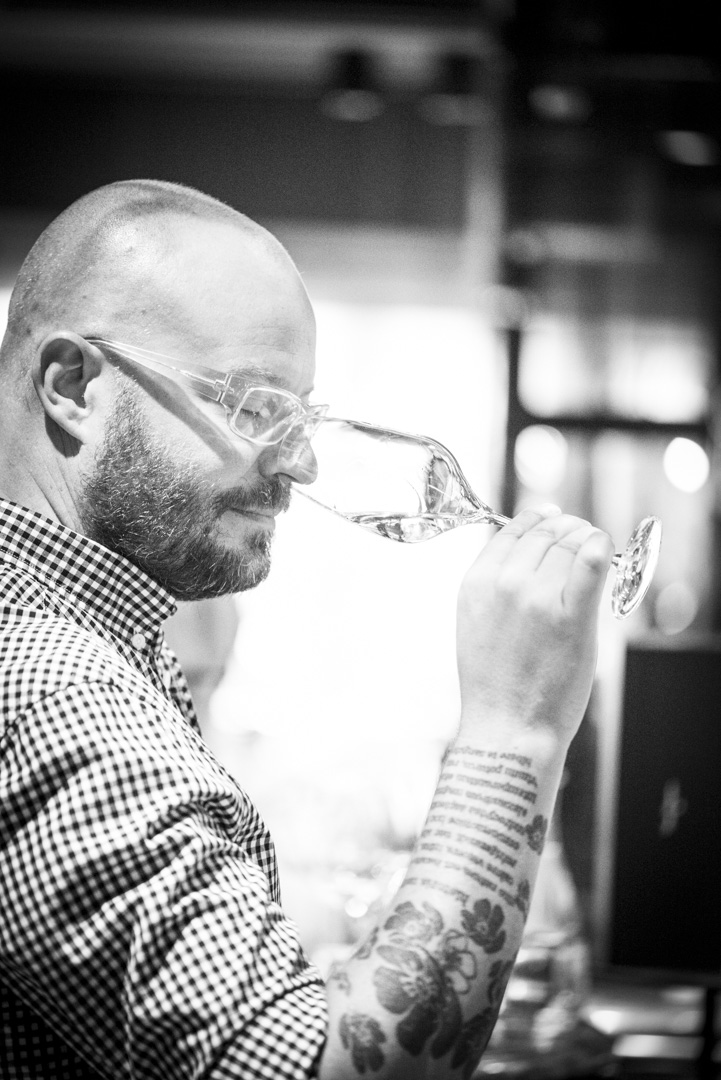
A worthwhile app should let you record more than aroma and score. It should support the structure of Champagne tasting itself: color and bead, first nose, development in the glass, texture, mousse quality, acid line, mineral expression, finish, and stage of evolution. Space for context is equally important. What was the serving temperature? Was the bottle just opened or did it improve after air? Was it tasted from magnum, with food, or in a comparative flight?
Cellar integration can also be decisive. Many enthusiasts do not need another generic wine journal. They need a system that connects tasting notes to ownership, purchase history, bottle count, and drinking windows. The ability to trace what you bought, what you opened, and what impressed you is where an app becomes commercially useful, not merely editorially pleasing.
Then there is the question of authority. User notes have energy, but expert notes bring calibration. If you are trying to refine your palate, benchmark your impressions, or buy more intelligently, access to a deep archive of credible tasting commentary is often more valuable than thousands of quick crowd ratings.
Why Champagne demands more precision than other wine categories
Champagne can look deceptively simple on a shelf. A famous house, a familiar label, perhaps a vintage declaration if you are lucky. In the glass, however, the category is layered with variables that shape quality and style in ways many apps are not designed to capture.
Take non-vintage wines. They are often treated as static products, but the best examples evolve meaningfully from release to release. A note on one bottling may not describe the next. The same is true of rosé, where blending choices can sharply alter personality, and of grower Champagne, where farming and village expression may define the wine more than brand recognition.
Disgorgement is another fault line. Enthusiasts who buy serious Champagne increasingly pay attention to release timing, bottle age after disgorgement, and condition. If your tasting archive cannot reflect that, its value narrows quickly.
This is why specialist ecosystems tend to outperform generic wine tools for dedicated Champagne drinkers. Breadth is useful, but depth is what sharpens judgment.
How to judge long-term value in a champagne app for tasting notes
The right app should still make sense to you in three years. That is a better test than whether it feels slick in the first five minutes.
Start with data quality. Is the wine library curated, accurate, and detailed enough to support serious retrieval? Then look at the note architecture. Can you build a disciplined record, or are you being nudged toward disposable reactions? Finally, consider whether the platform grows with your knowledge. A beginner can live with simplicity. An advanced drinker usually cannot.
There is also a practical financial angle. Fine Champagne is expensive enough that better note-keeping can improve buying decisions. If an app helps you avoid disappointing repeat purchases, recognize strong releases early, or identify which producers consistently fit your palate, it creates value beyond convenience.
For those who want not just a notebook but a deeper knowledge system, specialist membership platforms have a clear advantage. A resource such as Champagne Club, with its vast independent tasting archive and producer-specific expertise, offers a more meaningful framework than a generic app built to catalog every bottle on earth. That does not mean every drinker needs the same tool. It means your standard should rise with your ambition.
Choosing the best fit for your style of tasting
If your goal is quick logging and label recognition, a broad wine app may be enough. If your goal is sharper memory, better calibration, and more intelligent collecting, choose a platform that respects Champagne as a category with its own logic.
The best tasting notes are not decorative. They become a private map of your palate and a record of your education. Over time, they reveal patterns you would otherwise miss: which villages move you most, which houses reward patience, which dosage levels suit your table, which producers are worth following closely.
That is the real test of a champagne app for tasting notes. Not whether it makes logging easy, but whether it helps you read good and drink better. Choose the tool that makes your next bottle more intelligible than your last.
- Champagne Club app: https://apps.apple.com/us/app/champagne-club/id1527100676
- Champagne Club app: https://play.google.com/store/apps/details?id=com.champagneclub.champagne&hl=en&pli=1