
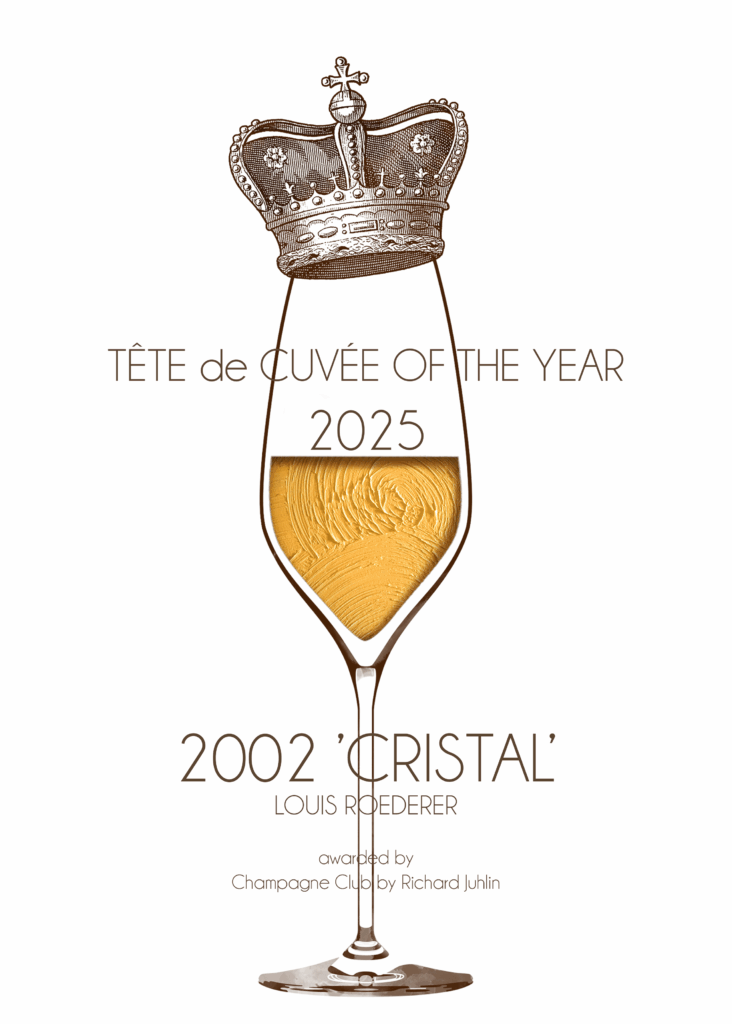
Or shall we call it ‘The Richards’ ?! Instead of ‘The Champagne Oscars’ ? We want to sum-up the year of 2025 from a Champagne perspective. In 20+ categories we hand out awards for this years most memorable Champagnes & Champagne related topics!
Estimated reading time: 4 minutes

Historical winners
| 2025 | 2002 Louis Roederer ’Cristal’ |
| 2024 | – |
| 2023 | 1985 Perrier-Jouët ’Belle Epoque’ |
| 2022 | – |
| 2021 | mv Laurent-Perrier ’Grand Siècle Itération N°23’ [magnum] |
| 2020 | 2008 Taittinger ‘Comtes de Champagne’ |
2002 Louis Roederer ’Cristal’
55PN 45CH
98(97)p
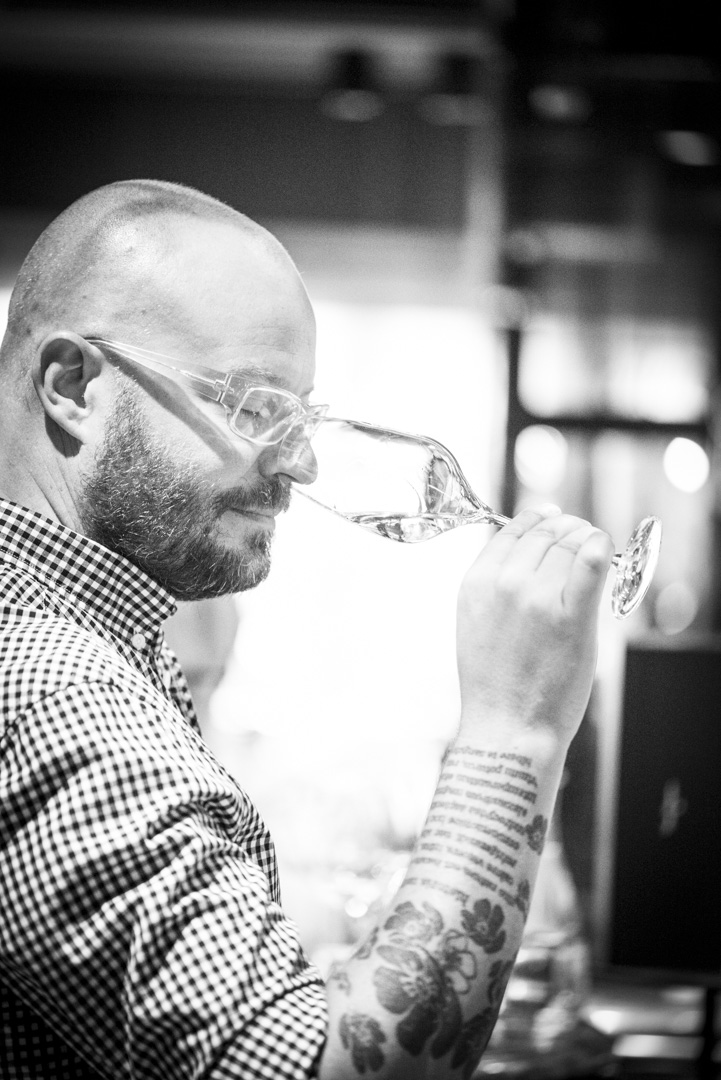
TASTING NOTE by Champagne Club by Richard Juhlin ‘My expectations were not entirely fulfilled since this wine plays in exactly the same league as the ordinary vintage wine and the Blanc de Blancs this time. Sublime and aristocratic of course, but not as full-bodied as the vintage wine. Wonderfully feminine elegance just a month later. Heroic and fantastic today. A bit closed in 2012 so wait. In 2021 perfect. Slightly more closed in 2023.’

Louis Roederer
★★★★
Roederer did not get its present name until 1833, but was in existence as far back as 1760 under the name of Dubois Père & Fils. Louis Roederer was a hardworking man who succeeded in selling his Champagne in several important export markets. Roederer’s real ace was, as with Clicquot, the Russian market. Tsar Alexander II wanted a more impressive label to show his guests, and in 1876 he made a special order for the first transparent Cristal bottles, which at that time actually were made of genuine crystal. The wine was stunningly sweet and gave Roederer had some problems with disposal after the Russian revolution, when the firm was stuck with unpaid invoices and stores full of sweet Champagne that no one else wanted.
The company recovered in the 1930s, when Camille Olry-Roederer took the helm. She invested the money earned from sales in some exceptional vineyards: in Aÿ, Hautvillers, Cumières, Louvois, Verzy, Verzenay, Vertus, Avize, Cramant, Chouilly, and Le Mesnil. More and more of their production and vinicultural is biodynamic. Roederer also owns several well-respected vineyards in other locations: Roederer Estate, Ramos Pinto, Haut-Beauséjour and Château de Pez. Today the firm is the most financially successful in the region, thanks largely to these vineyards, which supply Roederer with some 70 percent of its grapes.
The house is now run by Frédéric Rouzaud who works according to the same principles as those applied in past decades. Winemaker is the increadible Jean-Baptiste Lécaillon. One of the best winemakers in the world. All the wines ferment separately, cru by cru, in small steel vats or small barrells, while the reserve wines are stored in large oak barrels. This is said to give the company its special “vanilla touch.” I’m not alone in wondering if certain wines for the prestige variety Cristal aren’t aged in these barrels, as it is precisely in Cristal that one can sometimes discover a nutty, oily, and vanilla-tasting barrel-like character. Another explanation for this toffee-like note of maturity could be that they use a large portion of the best, older, oak-barrel-stored reserve wines in the dosage. Apart from this, up to 20 percent of the oak-aged reserve wine is used in the fantastic non-vintage Champagne Brut Premier. Roederer has no set recipe regarding malolactic fermentation the personal qualities of the wine differ from case to case. Roederer is without doubt a brilliant Champagne house with an exceptional portfolio of wines. The non-vintage Champagne Brut Premier is brilliant. The Vintage Rosé and Blanc de Blancs offer an aristocratic elegance typical of the house, and the vintage wine is always among the best. Cristal is today the most sought-after cuvée de prestige, and has perhaps the most appetizing appearance of any wine in the world. Cristal Rosé is not only the most expensive rosé Champagne—it is obviously the best.
‘In my opinion, this house is one of the four best in all of Champagne. Every vintage is stunning. Buy all the Roederer wines you come across from the most drinkable address in the world!’
Richard Juhlin